
A Most Valuable Process
or, What Went Wrong With the 2024 NFL MVP Vote

Training camp is starting! Rookies reported last Tuesday the 15th. Vets report today; the first full-squad practice is tomorrow the 23rd. It’s time – long past time! – to clear the decks of the last and most annoying bit of “old business” from last season.
This piece is crazy long. It’s probably four times as long as it could be. Please take that as an indicator of how wide & deep I had to dig, to purge myself of all the feelings I had pent up with this piece of business.
To make the piece more useful, there’s a Table Of Contents right after the introductory paragraphs below.
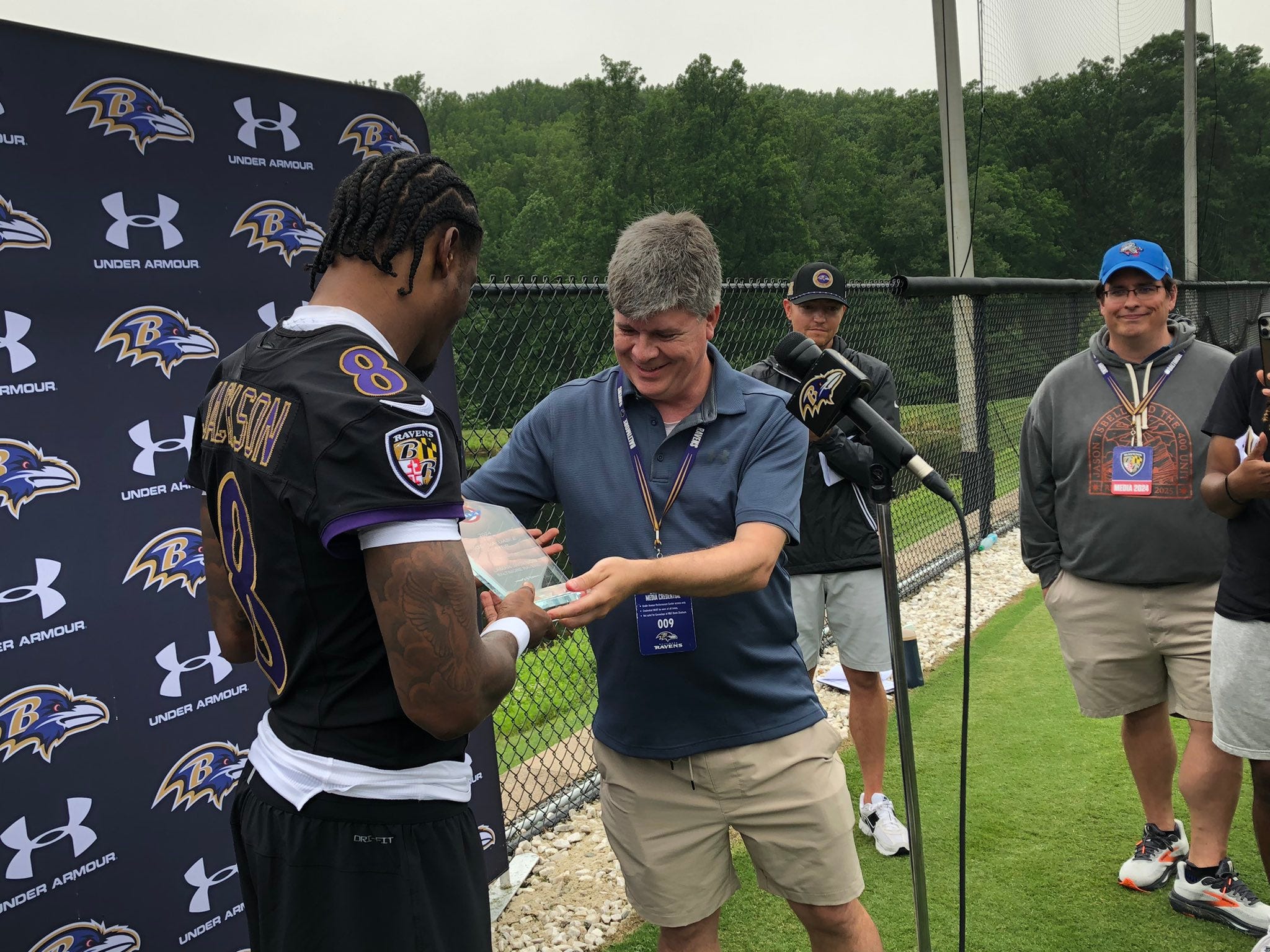
At mandatory minicamp in June, Jamison Hensley of ESPN and WBAL presented Lamar with the trophy for the MVP award voted on by the Pro Football Writers of America:
The PFWA first awarded an MVP in 1966 (to Bart Starr). Then they took 8 years off for some reason, but returned to awarding an MVP in 1974, and have done it every year since. The “writers” have been awarding the baseball MVP since 1931 – not the football writers, obvsly, the Baseball Writers Association – so having writers do it seems like a logical fit. The PFWA Association is one of the prestigious NFL MVP awards.
Another is the Bert Bell award. Bert Bell was Commissioner of the NFL 1949 to 1959. He seems to have been a hugely important figure, judging from his Wiki page. Before being commish he led his fellow owners in establishing the draft, which of course gives the weakest teams the best incoming players: a powerful driver toward parity. As commish he unilaterally recognized the NFLPA; he helped develop the first pension plan for players; he oversaw the racial integration of the league; implemented centralized scheduling; advocated parity; and persuaded the owners to adopt Sudden Death overtime. He set the policy of teams releasing early injury reports, to limit gamblers profiting on inside info, and he lobbied every state to criminalize the fixing of sporting events.
Bell passed away in 1959. The Bert Bell award was established then, “presented to the top player in the National Football League.” Johnny Unitas was the first recipient. It’s been presented every year since. This year the Bert Bell Award went to Saquon Barkley.
The Bert Bell and the PFWA are legitimately prestigious MVP awards with longevity and standing.
There have been other prestigious MVP awards. The Joe Carr Trophy was awarded in the early years of the NFL. The Sporting News chose an MVP from 1954 to 2006 (with a break in the 70s). The Jim Thorpe Trophy was awarded by the Newspaper Enterprises Association from 1955 to 2008. That one was voted on by the players, so it was especially meaningful. UPI awarded an MVP for 20 years mid-century.
But of course, none of those is the MVP award.
Table of Contents
I hope this piece will be useful in the future to readers as a reference on the various aspects of the 2024 NFL MVP award controversy. To aid that, here’s where to find everything that’s in here:
1. The PFWA's 2024 NFL MVP (top)
2. Controversial baseball MVPs and the elements of an MVP story
3. Just a small subset of MVP voters (and Josh Allen is not bad)
4. Full disclosure: yes, I'm a Lamar stan
5. The Josh-Allen-for-MVP arguments
6. AP voters motivations
7. Historical usage of the term "MVP"
8. Why 1987 is a bad year to copy
9. MVP QBs with All-Pro teammates
10. Who helps whom more, Lamar or Derrick Henry?
       Run game
       Pass game
       Henry's most important contribution: load management for Lamar
11. Josh Allen is better FOR BUFFALO than Lamar would be
12. Comparing the supporting casts
13. Relitigating the 2023 MVP award
14. Stats, intro
       Stats, advanced non-adusted
       Stats, advanced defense-adusted
       Stats, traditional
15. Josh Allen's rushing TDs
16. But the Bills beat the Chiefs!
17. Conclusion: Should changes be made?
Baseball’s Award, and the elements of an MVP story
In 1986, the great baseball writer and analyst Bill James said this:
I was surprised and disappointed in the National League MVP vote for 1985. Meaning no disrespect to [the winner], to my way of thinking it was obvious that the Most Valuable Player in the NL in 1985 was [a different player].
…
I didn’t expect that [vote]. I don’t understand it. I can’t justify it. And I don’t think it reflects very well on the award or the [people] who did the voting.
                                                                   — Bill James on Ozzie Smith, 1986
                                                                   reprinted in This Time Let’s Not Eat The Bones
I been waiting almost 40 years to use that closing line! 😆
I would have been in my early- to mid-twenties when I read that; probably not the same year it came out, but within a few years of it. That piece made an enormous impact on me. Lots of Bill James’ writing did; but this specific nugget, and its ideas that (1) there was a thru-line that clear thinking could identify, without fancy data analysis, that would lead one to the MVP; and (2) the major-sport-award community could succumb to a certain kind of groupthink and make an obvious, blatant error2 – those twin ideas paired with each other were eye-opening.
You can see how that would appeal to a guy who think he’s a smarty-pants. You can also see where I’m going with this: tie in the “wrongness” of that long-ago baseball MVP award with the 2024 NFL MVP. You know I’m going to use that line and tell you that I can’t justify the 2024 MVP vote, and I don’t think it reflects very well on the award or those who did the voting. Damn right.
But first let’s talk about another baseball MVP in the National League, this time the one for 1987. Bill James ripped that award too. He wrote that offseason:
There are occasions in your professional life which make you think you’re not making any progress. The election of Andre Dawson as the National League’s MVP is one of mine. … The reality is that the essential work of this book is to try to teach people not to [blindly] trust statistics. It was never my idea that … statistics are the best way to look at baseball. It was my point, rather, that people do make judgements about baseball players primarily by statistics, not should but do, and because they do they need to have a better understanding of what those statistics really mean.
…
So why did he win the MVP award? I know what some people will say. It wasn’t Dawson’s statistics. It was his leadership and his throwing arm. People will say that, but you know it isn’t. You don’t give an MVP for “leadership” on a last-place team. Half the time, the MVP goes to the league leader in RBIs. That’s not leadership; that’s statistics. And if they really understood his statistics, they wouldn’t have done it.
                                                                   — Bill James on Andre Dawson, 1988
                                                                   also in This Time Let’s Not Eat The Bones
You can see that the passion is directed not at Dawson, but at how people take in information and use it to make decisions. Whether people use statistics with thought and understanding, or without.
Bill James didn’t mention all the pertinent info in his writeup about Andre Dawson. There was another part to the 1987 Andre Dawson story that was vitally important. In the offseasons leading up to 1987, collusion between owners was rampant. As Baseball Reference writes:
After the 1985 season, at the urging of Commissioner Peter Ueberroth, owners came to an unwritten agreement not to compete with each other over the services of free agents, and to reduce significantly the length of contracts they would offer. As a result, free agents were forced to re-sign with their original teams for little or no pay raise, unless their team indicated that it was not interested in their services. Thus, players who should have been highly sought after, such as Detroit Tigers outfielder Kirk Gibson, who had hit 29 home runs and driven in 97 runs in 1985, found that no team was apparently interested in their services and had to stay put. Things got even worse after the 1986 season, when a number of top-notch players like outfielder Tim Raines of the Montreal Expos, pitchers Ron Guidry of the New York Yankees and Doyle Alexander of the Atlanta Braves, and catcher Rich Gedman of the Boston Red Sox, found absolutely no takers when they hit the free agent market after the season. ...
Expos' outfielder Andre Dawson was so disgusted by the situation that he basically offered the Chicago Cubs a blank check to sign him: desperate to get out of Montreal because of the pounding his knees were taking from the rock-hard artificial turf at Stade Olympique, he told the Cubs he would play for them in 1987 for whatever amount they were willing to pay him. Unable to claim poverty, the Cubs offered the ridiculously low one-year salary of $500,000 (less than a third of what Dawson would have been worth in a fair market), and Dawson signed.
Dawson tells his story here:
“The first team that came to mind was the Cubs obviously because it was still the National League, a natural playing surface, daytime baseball and a huge national following,” Dawson said. ... “The Cubs was top priority, and we decided, because spring training had already started, to take a trip out to Arizona, hopefully at some point meet with [general manager] Dallas Green, and just present him with the proposal.”
...
“He said, ‘Mr. Dawson, we’ve evaluated your proposal and the best offer that we can make you is $500,000.’ That was $500,000 less than what Montreal was offering me,” Dawson said. “I knew that I needed the change of scenery. I didn’t, at that point, want to go back to Montreal. I was always hoping that whatever the amount that would be written in wouldn’t be too embarrassing, but at that point for me, it got to be not a monetary issue.“I accepted the proposal and he kind of hesitated. He didn’t say anything for about 15 seconds. I said, ‘Hello?’ I thought I lost the call, and he said, ‘I’m here. Can I get back to you in about an hour?’ At that point, I knew what he had to do because he really wasn’t supposed to make an offer. He had to clear it with the commissioner moving forward. He called me back sure enough about 45 minutes later and said, ‘Andre, welcome aboard. We’re glad to have you and take your time. I know you were just here.’ I told him, ‘No, I can be on a flight and be back out tomorrow.'”
Dawson wrote in his autobiography, "I can't describe for you the feeling of elation I experienced as we walked out of Green's office that afternoon. I had taken back control of my own life."
Put on your sportswriter hat for a moment and let yourself FEEL the allure of this story. Dawson had gone hat in hand, begging for a contract, settled for being the lowest-paid regular on the team, and then led the league in RBI! Horatio Alger, eat your heart out. As ESPN put it, “It was a redemption and it happened to one of the nicest guys in the game. The writers loved it.” You betcher ass the writers loved it! They couldn’t possibly not love it. It was aimed right at their sweet spot.
The money soundbite I’m dying to use is the Bill James one about the 1985 award, about how I can’t justify the vote and I don’t think it reflects very well on the award or those who did the voting. But the elements – the wide diversity of the elements in play – is better captured by the 1987 episode. We see all of these in 1987:
Sportswriter desires
The power of “narrative” as story
The power of “narrative” as explanation of games
Misunderstandings or misrepresentations of statistics
1987 labor disputes
And they all figure in our current story.
Who am I mad at? Or, Josh Allen doesn’t suck
The award that is recognized as the NFL MVP Award is the one given by the AP. This year it went to Josh Allen.
I am appalled.
I would not have been appalled had Saquon won MVP. Seasons of 2k do not grow on trees, plus he jumped backwards over a defender: some real superhero shit. I kinda want to give it to Saquon just for that move. But Lamar did not lose the MVP to Saquon.
I’m not mad that Josh Allen got some votes for MVP. He played extremely well this past season, and the culture of the MVP award is not toward being unanimous. Only twice in MVP history has the voting been unanimous: Tom Brady 2010 and Lamar 2019. Jim Brown wasn’t unanimous! Not when he won in 1965 (Johnny Unitas came in 2nd!), not in 1958 (Unitas in 2nd again), not in 1957 (Unitas 3rd; YA Tittle was 2nd). Peyton Manning set the record with 55 TD passes and almost 5500 yards, and wasn’t unanimous (one vote for Brady). Three years earlier Tom Brady set the record that Peyton broke, throwing 50 TD passes, and he wasn’t unanimous (one vote for Brett Favre). Unanimity is not the standard for MVP. Never has been.
Lamar was named the 1st-team All-Pro Quarterback. The voting for All-Pro went like this:
                        Lamar          30 votes for 1st place
                        Josh Allen    18
                        Joe Burrow    2
If the MVP voting had gone something like that, with some also thrown to Saquon, maybe a rando to Jayden Daniels or Ja’Marr Chase, then I would have no complaints. The 2nd-team All-Pro QB is usually having a great-enough season to merit some MVP votes.
So I can’t be made at everyone who voted Josh Allen for MVP. He deserved some votes. That means I have to narrow my focus. 30 voters chose Lamar 1st-team All-Pro; but only 22 put him first on their MVP ballot. So 8 voters went the other way. 18 voters had Josh Allen as 1st-team All-Pro, but 27 put him first on their MVP ballot: 9 voters went the other way.
I am mad at 8 or 9 people.
Out of 50 MVP voters: that’s 16 or 18%. Sort of puts it in perspective. It’s a small group. I’m not mad at THE WORLD for perpetrating a colossal injustice: most people recognize that Lamar had the best season of all the QBs. Even the MVP voters recognize that Lamar was the best QB this past year! I’m not mad at the (18) voters who had Josh Allen as the 1st-team All-Pro QB. And I’m not mad at the (22) who had Lamar as 1st-team All-Pro and MVP. What & who I am mad it is that small number who knew that Lamar had the better season, acknowledged that Lamar had the better season, and voted Josh Allen MVP anyway. 8 or 9 people.
That’s really specific. It’s so specific that I considered listing them. But that seems like a bad idea: like targeting them for “retribution”. Those voters, who tried to work in good faith, do not deserve anything “happening” to them. The very worst I want them to get is a Tweet that their vote was wrong, with maybe a link to this piece.
I’m not ranting at the world. I guess I am ranting at 8 or 9 people. The target audience is specific; the arguments will be specific as well.
The last time a player won MVP without being 1st-team All-Pro at his position was 37 years ago: the 1987 MVP award. I told you above that 1987 would come up again. We dive into 1987 below, but in the meantime, see if you can think of any reason off the top of your head why “1987” sticks in your mind as an outlier NFL season.
By the way:
As I write this, I notice that it’s difficult to say to lay out a “Lamar deserved the MVP over Josh Allen this year” case without making it sound like “Lamar is great and Josh Allen sucks!” To be clear, Josh Allen does not suck. He’s very damn good. We’ll go thru some statistics below that help illustrate how damn good Josh Allen was this season. But it’s enough to say that he was the 2nd-team All-Pro QB this past season. That’s a damn good player: the 2nd-best QB in the league.
Also seems to be a good dude. Every time I’ve seen him saying something in public, he seems to have his head on straight. Says nice things about the opponents; seems to have embraced his city. Here’s a vid of him from a couple years ago, warming up before a preseason by playing catch with fans in the stadium:

Heart-warming.
I don’t hate Josh Allen – I mean, I have a minor “hate” for him as the QB of a conference rival, a team that has kicked my fave team out of the playoffs twice in recent years. Also as the player who’s most often contrasted with Lamar because they came from the same round of the same draft. But it’s an automatic, conditioned, reflexive, dispassionate sort of “hate”. Hard to get into it with any fervor.
Allen just isn’t very hateable. Decent dude, and a helluva player. You can’t question his work ethic off the field: his transformation from the terrible passer he was when he came into the league in 2018, to legit MVP candidate by 2020, bespeaks zillions of hours of diligent labor. And he plays with moxie on the field – showed that moxie even as a rookie.
I’m going to try an catch any instances of me leaning into “Josh Allen sucks!” phrasing as I write this piece. If you notice any as you read this, then that’s a place I screwed up and will want to edit.
Pardon my bias
Let’s acknowledge before we proceed: I’m in the tank for Lamar.
I was already a staunch Ravens fan before Lamar. I first started paying attention to the Ravens around the time Cleveland got the Browns restored to them in 1999 and it became “morally okay”. Baltimore was no longer in the position of having done to Cleveland what Indy did to them. (Hell, Cleveland got their team’s name & colors back! So we Baltimore fans could still feel mistreated.)
Then they showcased a playing style featuring great defense and hard running. I've often thought there’s a genius to that. If you want to win over fans with a deep football background – a championship background (even the CFL Colts won two championships!) – who’ve been locked out of the NFL for 15 years, if you can’t be good right off the bat then presenting them a squad that plays great defense is a surefire way into their heart. It appeals to their knowledge & appreciation of the game.
Then that team won a championship! I got hooked. Fast forward to the Joe Flacco years, I got more hooked. So: already a staunch Ravens fan before Lamar.
Lamar has taken my Ravens fandom up a level. Or ten. At this point I might even be a bigger Lamar fan than a Ravens fan: he’s SO impressive, both during gameplay and interacting with people and in his offseason prep. And “Lamar with kids” might be the purest relationship in sports:

 Tiktok failed to load.
Enable 3rd party cookies or use another browser
Jackson wore the bracelet to his postgame press conference and still had it on after Monday's practice. "I just like the bracelet, to be honest with you," Jackson said Monday. "I took it off, showered and stuff, before I came in today, I put it back on. It's a dope gift. [Points to cameras, maybe to the fan watching.] Appreciate you."
I’ve also had an “anchoring bias” around Josh Allen. Above I said that Josh Allen emphatically does not suck. But when he was coming out in the 2018 draft, I thought he was an inaccurate thrower who would suck. I might have been thinking something along the lines of Kyle Boller. Allen’s rookie season seemed to confirm that. I was slow to grasp it when he became an excellent QB around 2020 and beyond. I’ve been a solid year or two behind in my Josh Allen eval for the last few years of his career.
So: I’m wildly pro-Lamar, mildly neg Josh Allen (or at least slow to catch on about him). I am an imperfect observer. We reason with our biases as best we can3. Decide for yourself how big the pinch of salt is that you need to take my arguments with.
The 2024 MVP Claims
MVP voters who went for Josh Allen broadly said this:
1. The award isn’t called “most outstanding player”, it for “most valuable player”. Derrick Henry’s great season obviously makes Lamar less “valuable”.
1b. Lamar led the league in “receiver separation” this past season, which shows that Derrick Henry was pulling defenders and opening massive holes in the passing game. That clearly means Lamar was getting a lot of help.
2. Lamar had the better season, but Josh Allen was playing with so much lesser a supporting cast that Allen “did more with less.”
Additionally, some media members made arguments like this:
3. Josh Allen led the league in important stats like EPA-per-play and in Big Time Throw% (PFF). These establish that Josh under-the-radar had the best season.
4. Giving Josh Allen the MVP is a fair makeup call for awarding Lamar the 2023 MVP.
Also some fans made these additional arguments. I won’t discredit the AP voters by ascribing these to them; but let’s get all the pro-Josh arguments in one place:
5. Josh Allen had 12 rushing Touchdowns! Lamar only had 4 rushing TDs; therefore Josh Allen’s impact on the Bills having a good scoring offense was greater.
6. The Bills beat the Chiefs! They were the only team to beat the Chiefs (until the Chiefs rested all their starters in week 18). The Bills also beat the Lions. Thus they became the first team in history to beat two teams of 15 wins.
These arguments collectively are a rich concoction of ahistorical nonsense, motivated reasoning, statistical cherry-picking, and selective choosing of factoids while misreading the record. They evaporate with any careful examination.
But why?
If I’m right, and the claims outlined above are wrong, then —
Why would the voters choose the wrong player? If they used “motivated reasoning” to justify an obviously wrong choice; well, what’s the motive?
Basically, AP voters are critics & tastemakers, and Josh Allen is The Best Show You’re Not Watching. Josh Allen is Andor, or Slow Horses.
Part of it is has to do with the fact that Lamar has not won a championship, and his career postseason record is under .500. It’s easy to say that Patrick Mahomes is the best Quarterback in the game, and to keep throwing MVP trophies at him, when he’s taking his team to the Super Bowl and winning ‘chips. It’s easy to concede a 3rd MVP trophy to Tom Brady when he’s a a 5-time Super Bowl champ and leading the league in passing yards with a 32-to-8 TD/INT ratio at age 40. It’s easy to toss a 3rd MVP to Aaron Rodgers when he’s a proven Super Bowl winner and he sets the single-season Passer Rating record. It’s easy to award a 3rd MVP to Peyton Manning two years after he broke thru and finally won a SB, when he’s a traditional passer and clearly been the best QB in the league over the previous ~8 years and narrowly missed out on the last two MVPs because a couple Running Backs made history.
It’s not as easy to award a 3rd MVP, and basically put the player into the Hall of Fame, when the QB in question plays an “unorthodox style” and is under .500 in the playoffs.
I think the MVP voters felt that Josh Allen was too good a QB for Lamar to have a 3-0 lead over him in MVPs. A non-champ QB like Lamar didn’t deserve to be ahead of Josh Allen 3-0 in MVPs; Allen didn’t deserve to be behind Lamar 3-0.
Here’s the past 4 years of Quarterbacks, sorted by aYTS:
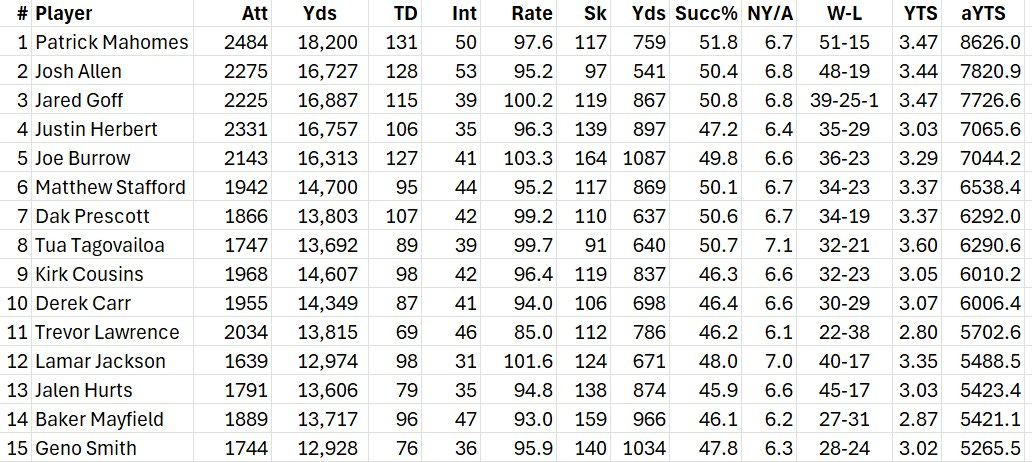
Over 2021-24, Josh Allen is 2nd in TD passes, 2nd in QB Winz, 1st in (lowest) Sack%, and 2nd in YTS. There’s a solid case that he’s been the 2nd-best passer overall these past 4 seasons, behind only Mahomes.
I think the feeling was, “It’s not fair for Lamar to have 3 MVP awards and Josh to have zero. Lamar isn’t 3-0 better than Josh – he may not be better at all!” So it was Josh’s turn to win MVP.
(Esp if you buy into the “Josh was robbed in ‘23” narrative.)

The “narrative” started early with Josh Allen:
Damn. What I want to insert here is a video clip I saw of Dan Orlovsky from last offseason, I believe it was on NFL Live, talking up the Bills and saying that they were going to have a great year. (Which they did.) The money quote I wanted to grab was, “I think the Bills Wide Receivers are good enough for Josh Allen to win the MVP this year.” That quote was something of a smoking gun.
It revealed motivation: a highly visible NFL media person stumping for Allen to win MVP before the season.
It undermined the supporting cast argument. Says that the supporting cast needed to be good enough to give the QB a chance to be the MVP. That cuts straight across the claim that too-good a supporting cast weakens a player’s MVP case.
It showed the shifting evaluation of the Bills receiving corps to be whatever is needed support the argument. Before the season, good enough that Josh could win MVP; after the season, so bad that Josh was obviously the MVP. Pervasive intellectual dishonesty.
Unfortunately, I can no longer find that clip. Someone tweeted it to Orlovsky with a “This you?” tag in reply to him talking about the MVP, I think back in January or February. I don’t seem to have bookmarked it, so right now it’s lost in time.
(If you stumble across that clip, please let me know!)
I am keenly aware that my narrating a clip from memory is not and cannot be as persuasive as you actually seeing it. If I find the clip, I’ll paste it here. In the meantime I’m going to ask you to trust that I’m describing the clip accurately.
Is it fair to put Orlovsky on the spot for an entire line of thinking? I think so, because:
Orlovsky is part of the Group of 8 or 9! He’s been quite vocal on several media outlets that he voted Lamar for 1st-team All-Pro and Josh Allen for MVP. He’s actually one of the very few people this polemic is pitched at.
Orlovsky is part of the every-day cast of NFL Live. He’s a highly visible commentator. His arguments get a huge platform.
Not to mention all the other platforms he’s on, First Take and Get Up and all the rest. Orlovsky is ubiquitous in NFL content.
In place of the lost Orlovsky clip, here’s Dominique Foxworth and Jeff Saturday arguing with Orlovsky on ESPN's Get Up. (Transcription by Mike Kadlick for SI.)
"Did he say most valuable player for his team?" asked Saturday. "Is this MVP of the league or of the Bills?"
...
"It does feel like you're trying to split the baby," said Foxworth. "You don't got the heart to say what you actually want to say. I think both of them had MVP-caliber seasons, but it feels like you are trying to find some little semantics trap door so you can give this to him, and that to them. Because you don't actually wanna say what you really wanna say: That Lamar Jackson had the best season this year."
By the way: credit to Orlovsky. He’s wrong, but he’s not being a weasel. He’s standing up for his (wrong) take, absorbing his lumps, and saying what he thinks. He is earnest and thoughtful. Wrong; but earnest and thoughtful, and willing to engage the conversation. I am not trying to beef with Orlovsky; nor encourage you to. He is earnest and he cares. Yeah, he’s wrong on this, but it’s not from being a wise-ass or for clicks. He digs into tape, works, and tries to call it as he sees it. He just persuaded himself into a mistake. He merits more respect being wrong here than lots of people do when they’re right.
In another bid to make up for the lost clip, there’s this Tweet from Scott Kacsmar. Kasmar is a member of the PFWA, so a voter for that MVP Award, but was not an AP voter this year. I enjoy him on twitter talking about this topic because he is snarky as hell; absolutely vicious. Here’s him just last month – the money quote is about Romo in the second tweet, circled, but I’m starting with part of the setup:
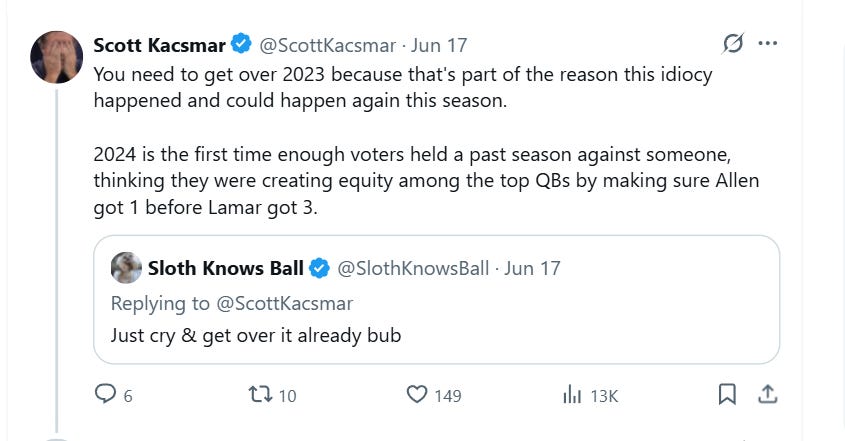

By the way, I have no problem with the idea that Josh Allen has been the 2nd-best QB overall these past 4 years, after Mahomes. But MVP isn’t supposed to be for career accomplishments or a great multi-year stretch. You’re supposed to win MVP by being the best player in a single season. The reason Josh Allen didn’t have an MVP before is because he hadn’t done that.
He still hasn’t.
Ahistorical Nonsense 1: “valuable”
The AP first gave an NFL award for the 1957 season, choosing the great Jim Brown. The articles that went “over the wire” for the AP reporting the event said that Brown had been chosen the NFL’s Most Outstanding Player.
Sports leagues honor MVPs. It’s an ancient rite; I wonder if it’s not an instinct. Maybe after our ancestors cornered a woolly mammoth and brought it down, they selected an MVP of the hunt. Other sports award MVPs:
Other sports
In baseball, back in 1910 the president of the Chalmers Motor Car Company offered to award a new car to the MLB player with the highest batting average. After some wrangling about whether Nap Lajoie or Ty Cobb finished with a higher average, Chalmers gave cars to both men and announced a change in the award. Henceforth it would go to “the most important and useful player to his club and to the league at large in point of deportment and value of services rendered.” That says “the league”: an award for each major league, you see, so two awards per year. The award was retired after 5 seasons (the Depression hit).4
MLB revived the idea of MVP awards in 1922, and the leagues awarded their own MVPs 1922-28. I read somewhere that those awards were not widely respected; I don’t know the story, but the leagues stopped awarding them. The Baseball Writers filled in the gap and started awarding their MVP in 1931.
The Professional Hockey Writers have been awarding the Hart Trophy since 1924. The trophy itself was donated by a Dr David Hart, whose son was longtime Canadiens coach and GM Cecil Hart.
The NBA started awarding the Maurice Podoloff Trophy, named for its first commissioner, for league MVP in 1956. That means that as of 1956 the NFL stood alone as the only “major professional sport” that did not award a best player.
Your Little League baseball team chose an MVP. When I coached youth basketball (10yo girls, and then the same group following season, 11yo girls) we awarded a team MVP. We – me and the asst coach – did not stop to think deeply about whether the “best” player was also the “most valuable”: we knew who the MVP was. People intuitively grasp that the MVP is for the best player.
Football
For the first few years the award the AP gave was called the Most Outstanding Player. This PDF of the 2015 NFL Fact and Record Book shows that on page 524. Look: it was the 1950s. No one was digging deeply into the semantics. The AP was a news outlet: picture a grouchy old news editor on a deadline.
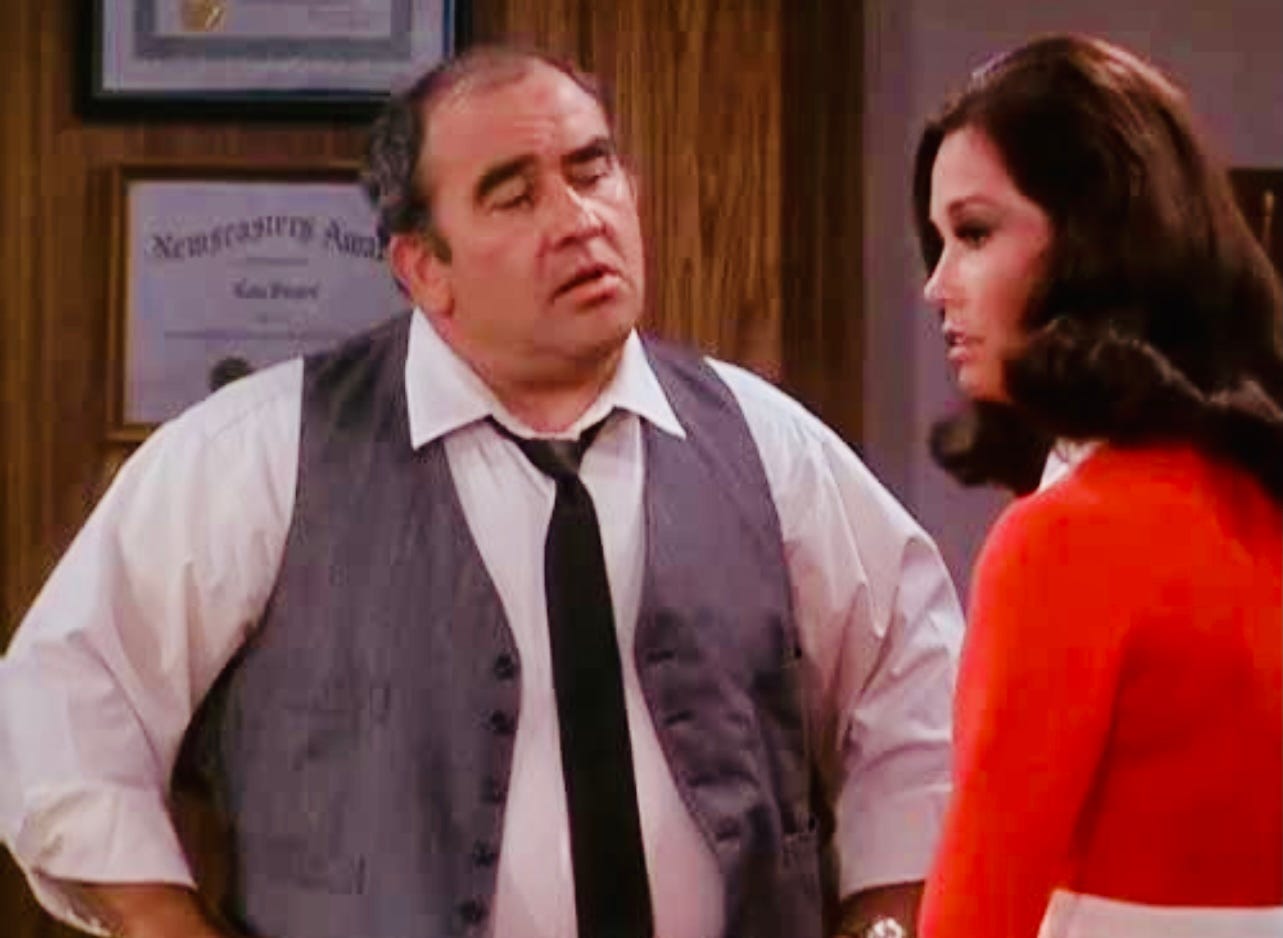
Newspaper editor.
They were in a hurry. And the NFL wasn’t a big deal. Hell: the AP didn’t even track their own award accurately. As late as 2009 the list they published of their own MVP award winners showed Gino Marchetti as their 1958 MVP. He wasn’t; he had been their lineman of the year, their actual choice for MVP was Jim Brown. For years they listed Charlie Conerly as their winner of the 1959 award. He wasn’t; Conerly was the NEA’s choice for the Jim Thorpe Award; the AP’s award-winner that year was Johnny Unitas.
If it sounds like I’m ragging on the AP for inaccuracies, that’s not my intent. I’m trying to illustrate how different the era was. The NFL was a Mom-&-Pop operation at least into the 70s. No army of dedicated fact-checkers, no Pro Football Reference to make sure everything was accurate, no Aaron Schatz (or Pete Palmer) to analyze the stats. It was just sports. The AP shot from the hip, elected a player, and moved on. They did NOT spend a lot of time analyzing the semiotics of the word that falls between “most” and “player”.
John Turney writes for Pro Football Weekly in Jan of 2010:
In the minds of many, if not most, the terms "MVP" and "Player of the Year" are synonymous, having the same meaning and … the AP used those terms interchangeably during the time period in question.
In 1958-59, the term used was "Player of the Year." In 1961, it was MVP. However, in '62, the story that moved over the AP wire was that Jim Taylor was the "NFL Player of the Year." In '63, the AP returned to using the term "MVP."
Turney has one part of that wrong: in 1958-60 the term was “Most Outstanding Player”. But he’s right on the important stuff: the timeline, the 1962 usage of “Player of the Year”. Overall the AP spent six years waffling between “Most Outstanding Player” and “MVP” and “Player of the Year”. It was the same award. But imagine yourself a newspaper editor, and ask this question: which takes up more column inches on a crowded sports page: “Most Outstanding Player” or “MVP”? The AP eventually settled on MVP. It’s short & punchy, and everyone understands it, because it matches the practice of the NBA and MLB and your Little League team.
Turney begins his last paragraph with this:
Perhaps the AP should listen to the logic of a 1965 New York Times headline that read, "Brown Is Named Player of Year; In Other Words, Most Valuable."
There was never a difference.
You might think I am overstating this; doing a lot of hand-waving to try to make a real difference in words disappear. Well: brace yourself.
Above I mentioned the Bert Bell Award. The award is bestowed by The Maxwell Football Club. The club was founded in 1935 by Bert Bell, then owner of the Philadelphia Eagles. It was named after a famous football player (college & pro) named Tiny Maxwell. Must’ve been very famous: he had passed away a dozen years before the club named itself after him. Wikipedia says the club was formed “to promote safety in football”, and there’s an interesting story about Maxwell and football safety.5
Please navigate to the organization’s homepage, The Maxwell Football Club. On that home page, please navigate to the page for the Bert Bell Award:
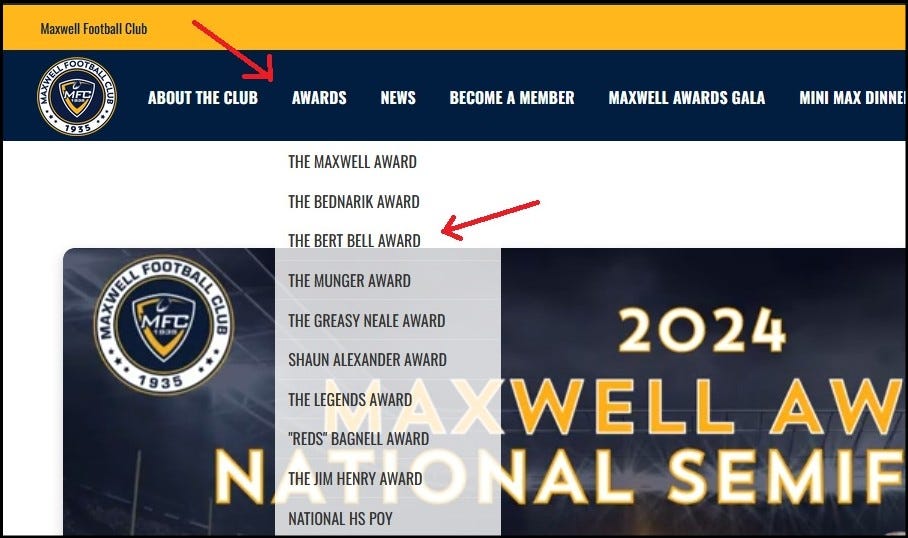
If they haven’t changed it, you’ll see this:
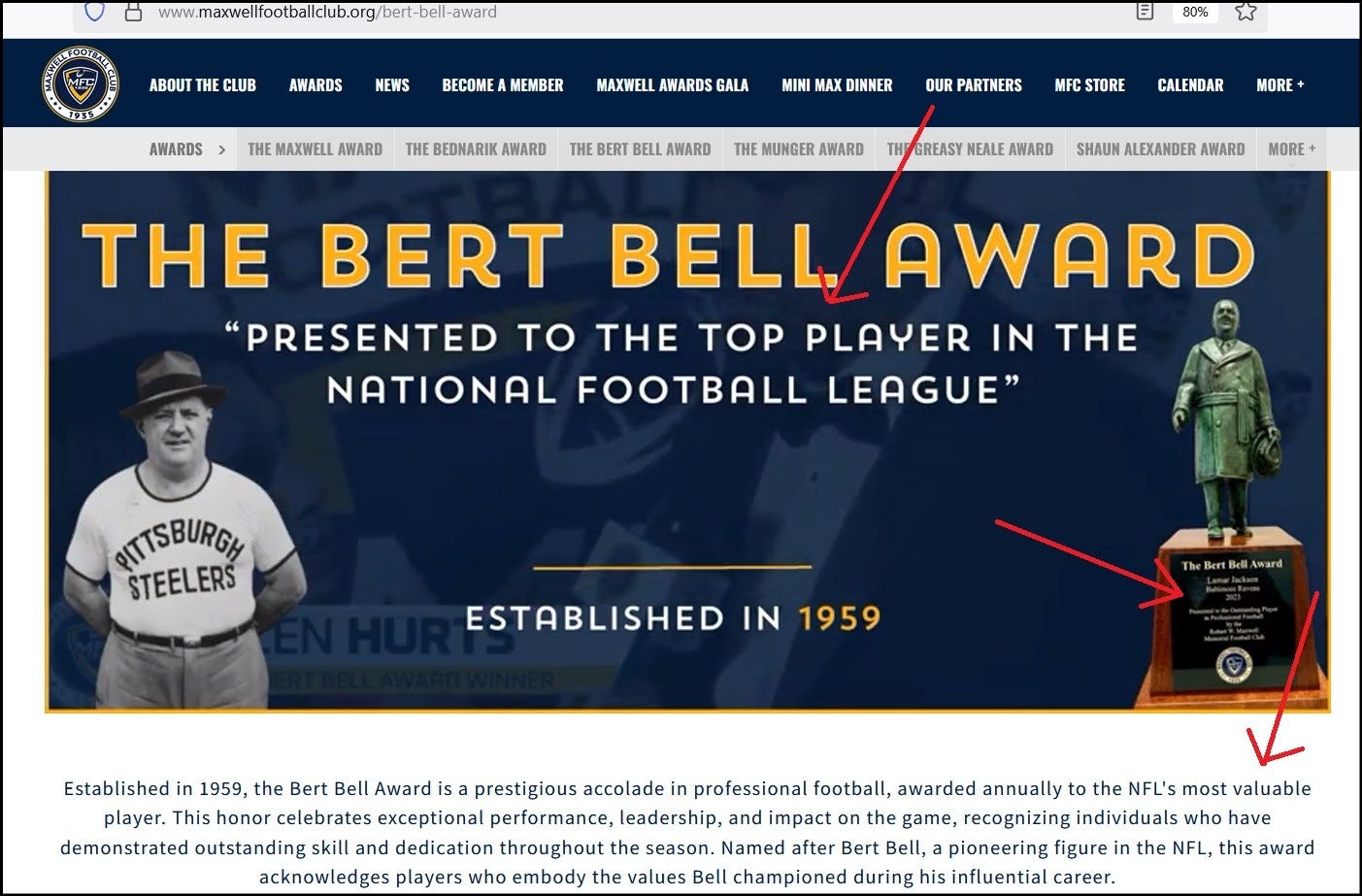
The tubby guy on the lower left is Mr Bert Bell, in the years after he switched from owning the Eagles to owning the Steelers. The more prosperous looking figure on the trophy, lower right, is Mr Bell in his later years, after he was bought out in Pittsburgh and became commissioner of the NFL. Now let’s look at the text pointed to by the three red arrows.
● Top: “presented to the top player in the NFL”
● Middle: this is a photo of Lamar Jackson’s trophy from 2023. It’s a little blurry, but if you squint, you can see that it says it is “Presented to the Outstanding Player in Professional Football.”
● Bottom: the caption under the photo says the award is a prestigious accolade “awarded annually to the NFL's most valuable player.”
These terms “top player”, “most outstanding player”, and “most valuable player” are all on the same page at the same time describing the same award! They are, and always have been, interchangeable terms.
My impression is that of the organizations behind the major MVP award, the Maxwell Club is the most “conservative” – not necessarily politically (though maybe that too) but in terms of “conserving the past,” or being tradition-bound, or backward looking. So when we see them using those terms interchangeably, that’s the most concise illustration of the historical usage of those terms:
“top player” = “most outstanding player” = “most valuable player”
I’m not saying it’s ridiculous to think one player might have been more “valuable” to his (good) team than another player who had a more “outstanding” season. Not at all. “Value” in team context is always worth thinking about for an analyst. There was a comment on an old piece at Football Outsiders – that site had a hella informed and interesting set of commenters – that has always stuck in my mind. In response to a discussion about “value”, some commenter (wish I remembered who) wrote:
“Superman himself would be worth nothing to the 1972 Dolphins.”
That really burned itself into my brain. The greatest imaginable football player could not have increased the ‘72 Dolphins win total one iota. On the flip side, Kirk Cousins would probably have been worth 6 to 8 wins to the 2011 Indianapolis squad. Team context can make a big difference.
It’s not ridiculous to think about whether there is a difference between greatness and value in a particular season. But it’s not consistent with the history of the MVP award to apply that kind of thinking to the award.
This year’s AP voters interrogated the word “Valuable” deeply to ascribe a different meaning from “Outstanding” because they wanted to. Not because it was ever historically justified.
1987? Seriously?
1987 was the last year that a QB won the AP MVP award, without being named 1st-team All-Pro.
I think you or I would look at that (hasn’t been done in 37 years?) and we would wonder if we were making a mistake. “Why are we deviating from the well-established standard?” I think the AP voters look at that and go “Cool! We are making news! 37 years is a story!” I hate that; but the AP voters are reporters and commentators and analysts. They can’t help it, it is literally their job to identify and amplify stories.
If it’s a “story”, it’s a cautionary tale. The awards voting that year:
It unusual to see a WR so high in the MVP voting. Another callback to this year; Tyreek Hill was firmly in the MVP conversation until the last ~month of the season.
An aside on Jerry Rice
Rice set the record that year for receiving TDs with 22. Overall he made the MVP leaderboard six times in his career:
From a distance, his best cases seem like the last three, esp 1995. He had about 5,050 yards over those three seasons and 47(!) TDs. It was Jerry’s world: the rest of us were just living here.
In 1995 Rice set the receiving yardage record (with 1,884!) and scored 16 TDs. That seems plenty MVP-ish to me. However, Brett Favre led the league in passing yards, TDs, and TD percentage: a solid set of credentials in its own right. Favre was named MVP, the first of his three consecutive. Emmitt Smith finished 3rd in the 1995 voting; and Jim Harbaugh(!) got 2 votes.
All that is totally irrelevant to the topic at hand. I just can’t resist dwelling for a second on how absurd Jerry Rice was.
Back to Joe Montana, John Elway, and 1987
For modern day baseball writers & analysts – and certainly MVP voters – the year 1987 should ring a bell. Was there anything different about 1987?
Why yes! Remember I mentioned way up top that 1987 labor disputes would figure into this story? There was an NFL strike in 1987! A players strike was called after week 2. The week 3 slate of games was cancelled, and the games in weeks 4-5-6 were played with mostly replacement players. But not entirely with replacement players:
Montana Crosses Line
LA Times Archives – Oct 8, 1987
Thirty-seven more players, including Joe Montana and 11 of his San Francisco 49er teammates, crossed NFL picket lines Wednesday in time to pick up this week’s paychecks and prepare for this weekend’s games.
Montana played in 2 of the Niners 3 games against replacement players. He led the league with 31 TD passes that year, which is a fine credential for an All-Pro QB. But 5 of those TD passes were thrown against replacement players. Did the voters factor that in, when they chose their MVP?
(A user on Reddit called Bipedal Moose wrote a nice breakdown of the 1987 MVP rave, which is worth a read.)
There was a solid reason for knocking the 1987 All-Pro QB down to second in the MVP voting. But that reason had no applicability to 2024. Lamar didn’t cross any picket lines. Lamar didn’t throw any of this TD passes against replacement defenses. In other words 1987 had no value as “precedent” for the 2024 MVP vote. The circumstances just don’t apply.
For fun, and since we’re here, I’m going to dive into comparing the 1987 Broncos offense to the 2024 Bills. But this is “extra”: the strike already dissolves any argument that 1987 was like 2024, or that there was precedent for dropping the All-Pro QB behind some other QB in the MVP voting.
Who sucked more, Elway’s 1987 supporting cast or Josh Allen’s in 2024?
The 1987 Broncos finished as the #1 seed in the AFC. They posted wins against playoff teams Seattle (twice), Chicago, along with near-playoff-teams San Diego (twice) and New England, and a Buffalo team that was about to start a playoff streak. They finished with the #5 offense by DVOA.
Sammy Winder led the team in rushing with 740 yards; Elway and the Fullback were 2nd & 3rd with 300 yards. Here’s everyone who caught 10+ passes for them that year:
With all due respect, this group of receivers sucks.
Vance Johnson was a decent player. The Broncos had drafted him two years prior at the end of the second round; a couple years after this he would post an 1100-yd season, before declining.
Ricky Nattiel was the Broncos 1st-rounder that year, a smurf receiver who never developed. His 630 yards in this season represent his career high.
#3 WR Mark Jackson was also a decent player. This is not the Mark Jackson who played Point Guard for the Knicks and Clippers and Pacers in the 90s, and then coached the Warriors before Steve Kerr. Different guy. This Jackson was a pint-sized 6th-rounder who put together a 9-year career averaging 600+ yards per season.
I have literally never heard of their Tight Ends, Clarence Kay and Bobby Micho. Kay had a 9-yr career with the Broncos, averaging about 240 yards a season.
This is just a bunch of guys. Offensive Coordinator Mike Shanahan and TE/Receivers coach Chan Gailey worked miracles here.
You can see the ghostly outline of an argument that Buffalo ‘24 was like Denver ‘87: a great QB dragging a weak supporting cast to a strong offensive performance, while the All-Pro QB had a great teammate splitting the MVP vote. You can see a sketch: but the argument dissolves if you look straight at it. Derrick Henry did not get a single vote for MVP, so there was no split. This Bills supporting cast was much stronger than the 87 Broncos supporting cast:
Cook > Winder. This is closer than I want it to be; Winder was a 2x Pro Bowler (like Cook), and Winder played 9 seasons, which is very solid. But Cook is younger, has his 2 Pro Bowl appearances in just 3 seasons; Winder never hit 4 yards-per-carry in any season, while Cook has a season of 5.7(! – his rookie year) and 4.9. Also Cook is a factor as a receiver, which Winder was not.
Bills Tight Ends > Broncos guys. 2nd-yr man Dalton Kincaid was a 1st-rd pick who finished 11th among TEs in receiving yards as a rookie. Dawson Knox is a 6th-yr player and former Pro Bowler. The Bronco’s TEs were – sorry guys! – complete nobodies.
The Bills WRs are better than the Broncos guys.
Really we should wait several more years to see their careers play out before we make a ruling on this Bills WR corps. But the argument arises now, so let’s sift the two groups.
As I see it, Khalil Shakir is comparable to Vance Johnson. But Shakir might have Pro Bowls in his future, which Johnson did not. Keon Coleman is better than Ricky Nattiel, and Mack Hollins is comparable to Mark Jackson. The Bills depth really illuminates the difference between the two groups. Rotational WR Curtis Samuel has been as consistently productive on his career as any WR the 87 Broncos had: he couldn’t establish himself as a full-time starter with the Bills. Amari Cooper came over in a midseason trade: obviously for career value he blows away anyone John Elway had to throw to in 1987, but he was slowed by wrist and back issues and failed to establish himself on his new team. The Bills didn’t bring him back. Still posted a YTS of 5.8, which is above-avg for a Receiver.
The 87 Broncos WR corps was shockingly bereft of talent. The current Bills WR corps is “unestablished”, and I wouldn’t put it in the top half of the league, but it’s not a desert wasteland like Denver’s was.
The 2024 Bills had Pro Bowlers at:
Left Tackle
Center
Running Back (consecutive Pro Bowl seasons)
and a former Pro Bowler at Tight End
Elway led the league (shared the league lead) in 4th Quarter Comebacks; an aspect of the game where he had already established himself as a monster, and really the cornerstone of his Hall of Fame resumé.
Elway and Shanahan and Gailey really made chicken soup out of a sow’s ear that year. We’re going to revisit the Bills “supporting cast” below, so I’ll leave this lie for the moment.
Summary: why 1987 is a bullshit model for the 2024 MVP
Wrapping it up:
1987 labor dispute
The 1st-team All-Pro QB crossed the picket line
and threw 5 of his TD passes against replacement players
while his teammate split MVP voters
Gratuitous extra: and the other guy’s supporting cast was shockingly poor
Reaching back to 1987 was ridiculous and unjustified.
Ahistorical Nonsense 2: the All-Pro teammate
The presence of Derrick Henry on the Ravens did not and could not make Lamar less deserving of the MVP award. Here are the last 50 years of Quarterbacks in the AP’s award:
In the table above6 every single player listed in the “teammate” column made either 1st- or 2nd-team All-Pro that year, except the two marked with an asterisk:
1989 Roger Craig: merely Pro Bowl that year, had been Offensive Player of the Year the season before
1978 Franco Harris: merely Pro Bowl that year, his 7th of 9 consecutive Pro Bowls, but had been 1st-team All-Pro the season before
For All-Pro Teammates I mean only “skill position” players or players at fantasy-relevant positions. Thus in 2019 I say that Lamar had “no” All-Pro Teammates. Actually Marlon Humphrey made All-Pro; but he plays defense. And Ronnie Stanley made All-Pro; but he's not a skill / fantasy-relevant player, he’s an O-lineman. Here we are talking just about Running Backs / Wide Receivers / Tight Ends.
In the past 50 years the NFL selected 52 MVPs.
Two seasons had co-MVPs. 1997 had Barry Sanders & Brett Favre, and 2003 had Steve McNair & Peyton Manning, so that’s why we get 52 out of 50.
Of those 52 MVPs, 39 were Quarterbacks (all listed above), 11 were Running Backs (not shown), 1 was a Kicker(! – 1982, a strike year), and one was a Lawrence Taylor.
Here are those as percentages.
Of the 39 MVP Quarterbacks, 26 of them (⅔) had an All-Pro teammate at the “skill positions”, and only 13 did not. So it is far more common, twice as common, for an MVP QB to have an All-Pro skill-position teammate than not to. Half of all MVPs were a Quarterback with an All-Pro teammate! QBs without an All-Pro teammate made MVPs about as often as Running Backs were MVPs.
This makes sense when you think about it. Quarterbacks only amass an MVP-type resumé when teammates are gaining yards. The production has to be spread around, for a QB to be producing at all: the offense has to be moving and gaining yards. Those QBs above who didn’t have teammates making All-Pro, had teammates making the Pro Bowl. (Not Elway ‘87, but most of them.)
Batman usually has a Robin. “Usually” = ⅔ of the time that Batman has a Robin; often two Robins (10 of 26).
THAT’S FIFTY YEARS!
The idea that Derrick Henry’s presence weakened Lamar Jackson’s MVP case is ridiculous. Good lord:
Travis Kelce and Tyreek Hill did not mean Patrick Mahomes wasn't MVP in 2018.
Randy Moss and Wes Welker did not derail Tom Brady’s bid for 2007 MVP.
Marvin Harrison and Edgerrin James did not disqualify Peyton Manning in 2004.
Isaac Bruce and Marshall Faulk did not keep Kurt Warner from the 1999 MVP.
Jerry freakin Rice and John Taylor and Roger Craig* didn’t stop 1989 Joe Montana.
Lynn Swann and Franco Harris* did not bar Terry Bradshaw from the 1976 MVP.
But Derrick Henry disqualifies Lamar from being MVP??
Previously in this history of the MVP award, adding an All-Pro teammate has taken a Quarterback over the hump in MVP voting:
● Tom Brady had finished 3rd in MVP voting in 2003 and 2005. He didn’t win MVP until the Pats added Moss and Welker. That made him MVP.
● Joe Montana had finished 2nd, 5th and 6th in MVP voting, until 1989 when John Taylor made 2nd-team All-Pro. That gave Montana a second All-Pro Wide Receiver, in addition to Jerry Rice, who had made 1st-team All-Pro each of the previous three seasons. That was when Montana when MVP: when the Niners “added” a second All-Pro WR.
But adding Derrick Henry weakened Lamar as a candidate? That’s just bullshit.
Is it clear how empty and nonsensical this argument is? And that’s before we even consider who helped whom more – before we even wonder whether Henry did more to help Lamar or Lamar did more to help Henry. That’s irrelevant. It’s never mattered before.
This year’s AP voters treated Lamar differently from other Quarterbacks in the past, because they wanted to. Not because it was historically justified.
Who helps whom?
There was already a believe among a certain segment of MVP voters that Derrick Henry “opened things up” for Lamar. Then a stat that went around the socials several months ago, that Lamar had the highest average receiver separation of any Quarterback in the NFL this past season. Josh Allen’s receivers had a much lower figure.
That cemented this idea: that Derrick Henry made Lamar Jackson this past year.
Way back up in the first section of this piece I suggested that there are two types of “narrative” at play. There is narrative as story, like the story of Andre Dawson going hat-in-hand to offer a blank contract, then leading the league in RBI. This is the second type of narrative: narrative as play description. It’s a logical explanation drafted to explain how events unfolded on the field to produce a stat. It’s not narrative like, “Josh Allen is so good that he doesn’t deserve to be behind 3-0 to Lamar in MVPs.” This is narrative like, “The stat illustrates how Derrick Henry’s presence opened things up for Lamar down the field, creating open receivers.”
On one hand, the idea that Derrick Henry “helped” Lamar is irrefutable. Obviously two great players help each other. Joe Montana helped Jerry Rice, and Rice helped Montana. Johnny Unitas helped Raymond Berry helped Johnny Unitas. Peyton Manning helped Marvin Harrison helped Peyton Manning. Lebron James helped Dwayne Wade helped Lebron James. Magic Johnson helped Kareem helped Magic. Tim Duncan helped Manu Ginobli helped Tim Duncan. Great players amplify each other. That's why teams try to stack talent.
Of course Lamar and Henry helped each other.
On the other hand, the bulk of the evidence is very clear that Lamar did more to help Henry than Henry helped Lamar. It’s impossible to miss this if you dive deep and examine the whole picture.
Let’s do that a moment; we’ll deal with the run game and pass game separately. But first I want to deal with this other idea:
        The Ravens were 9-0 when Derrick Henry rushed for 90+ yards
        They were 2-5 when Henry rushed for less than 90 yards.
        Therefore Henry was the driver of their wins.
You may have seen this all over the socials. It sounds plausible: Bills fans love it. There are just two teeny problems with this argument.
A) Running Backs tend to rack up yards in team wins. That’s the usual cause-&-effect relationship.
B) Look at this table, Lamar’s Passer Rating with the Ravens results:
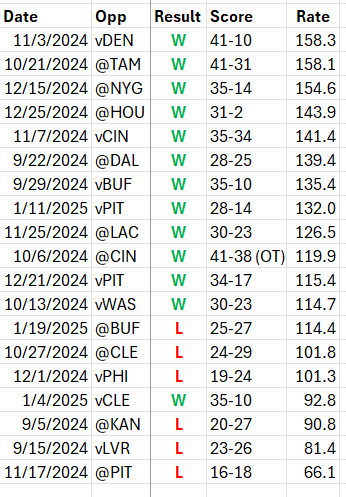
The Ravens went:
        12-0 when Lamar had a Passer Rating over 114.5;
          1-6 when he had a Passer Rating below 114.5.  (Includes playoffs.)
The 2nd-leading QB by Passer Rating this past season was Jared Goff, at 111.8.
The Ravens only won when Lamar played better than the 2nd-rated passer in the leaugue.
The “wins driver” was the Quarterback. As usual.
Run game
I’m going to start from theory, which of course is not “evidence”, it’s theory. But it’s something that’s well established. Then we’ll move on to actual evidence, on film and in stats.
– In theory
We’ve known since Michael Vick and Colin Kaepernick that a good running QB is a rising tide that lifts all boats in the rushing game. This is not news. When a QB is running the ball, he changes the math for the defense. Usually the defense has a +1 advantage in tackling the Running Back; but when the QB is running, that numbers advantage goes away. And when a running QB is not actually carrying the ball, his threat forces the defense to assign someone to stay with him in case he is running, which again takes away the numbers advantage that a defense uses to stop the run.
Vick elevated Warrick Dunn and TJ Duckett, and their 3-headed rushing attack took the Falcons to the 2004 NFC Championship Game. Colin Kaepernick worked with Greg Roman’s option tactics and the great Frank Gore to take the 49ers to three straight NFCCGs and the Super Bowl.
Lamar Jackson took those same tactics and elevated Gus Edwards and Mark Ingram; later, Devonta Freeman and Latavius Murray and Kenyan Drake. Just because the new back is Derrick Henry doesn’t mean we have to FORGET that a running QB helps his rushing teammates. Derrick Henry isn't different – well. Henry is different. He’s built different; his impact on the game is different. But the mechanism is not different. Lamar draws defensive attention. That elevates a good back like Mark Ingram to Pro Bowl status. It elevates a late-career Hall of Famer back up to All-Pro status.
That’s “narrative”, not as story but in the sense of using description to lay out a play mechanism; and it’s “theory”. But it’s pretty damn well established. With this in mind, about how a running QB impacts a team’s rushing attack, we should expect to see Lamar’s presence help Derrick Henry when we go to the tape. And that’s exactly what we do see.
– On film
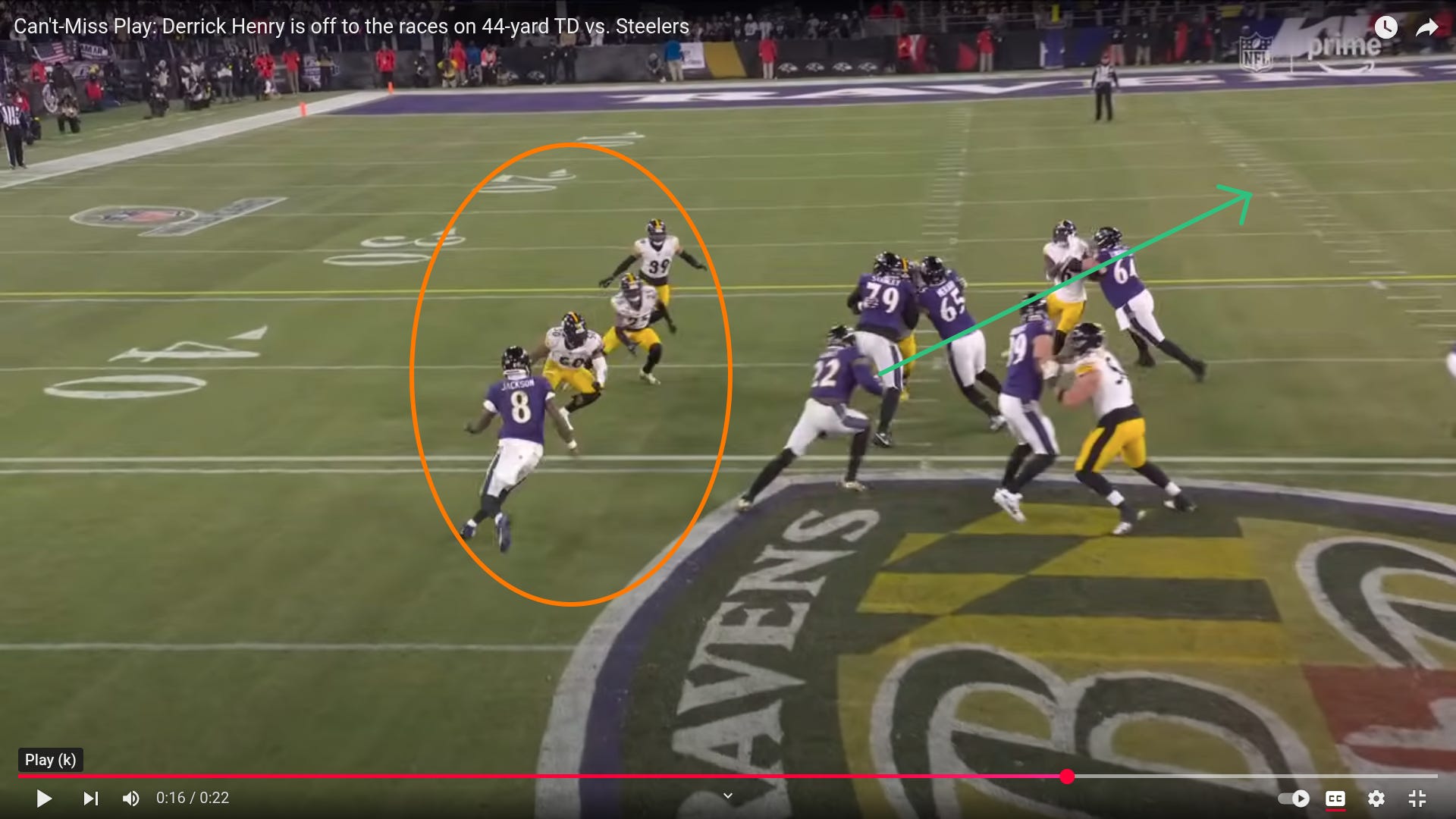
Let’s start with one play, from the Ravens-Steelers Wild Card game, to illustrate this. Here’s Henry’s 44yd TD run:
From the broadcast view, you’re like “Oh there’s Derrick Henry carrying the Ravens again.” Then they show the end zone replay. Here’s a freeze frame from that replay:
Reverse angle:
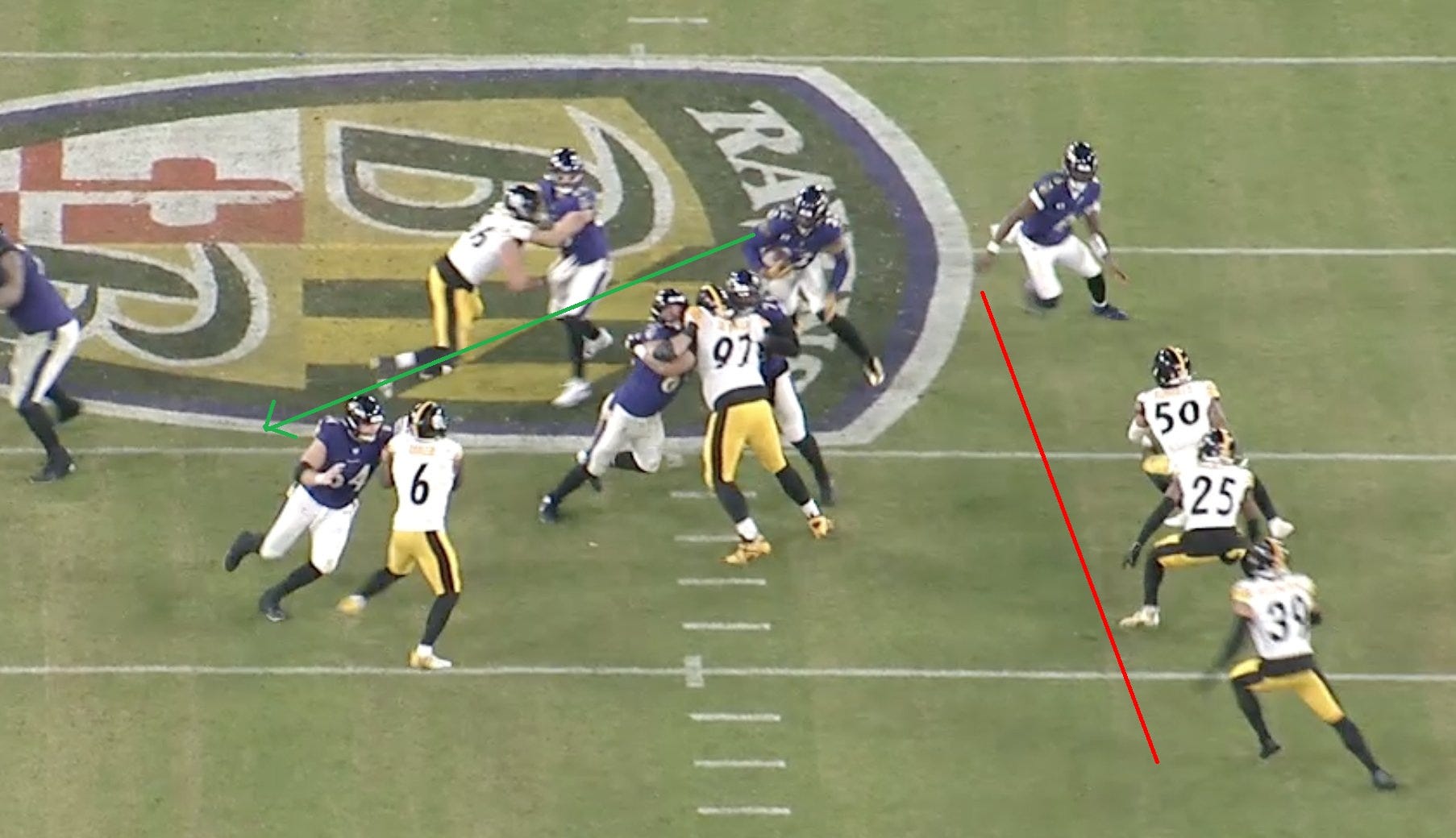
Three defenders took themselves out of the box to track Lamar, leaving the Ravens with 5 blocking 4 and Derrick Henry going “Sweet! Bye.”
Dots on Henry’s run:

Brutal misplay by the Steelers.
Now, this play is not typical, just because of how many defenders take the cheese and how far out of the play they run. You don’t usually see three defenders run themselves 5 to 10 yards away from the action. Three defenders is a lot, and 5-10 yards is far.
But this play is only extreme, not different in kind from what happened all year. Here’s Derrick Henry’s 2nd-longest run of the regular season, 81 yds in Tampa:

Look at this defender on the left edge, hesitating to make sure he doesn’t lose contain on Lamar on the back side:
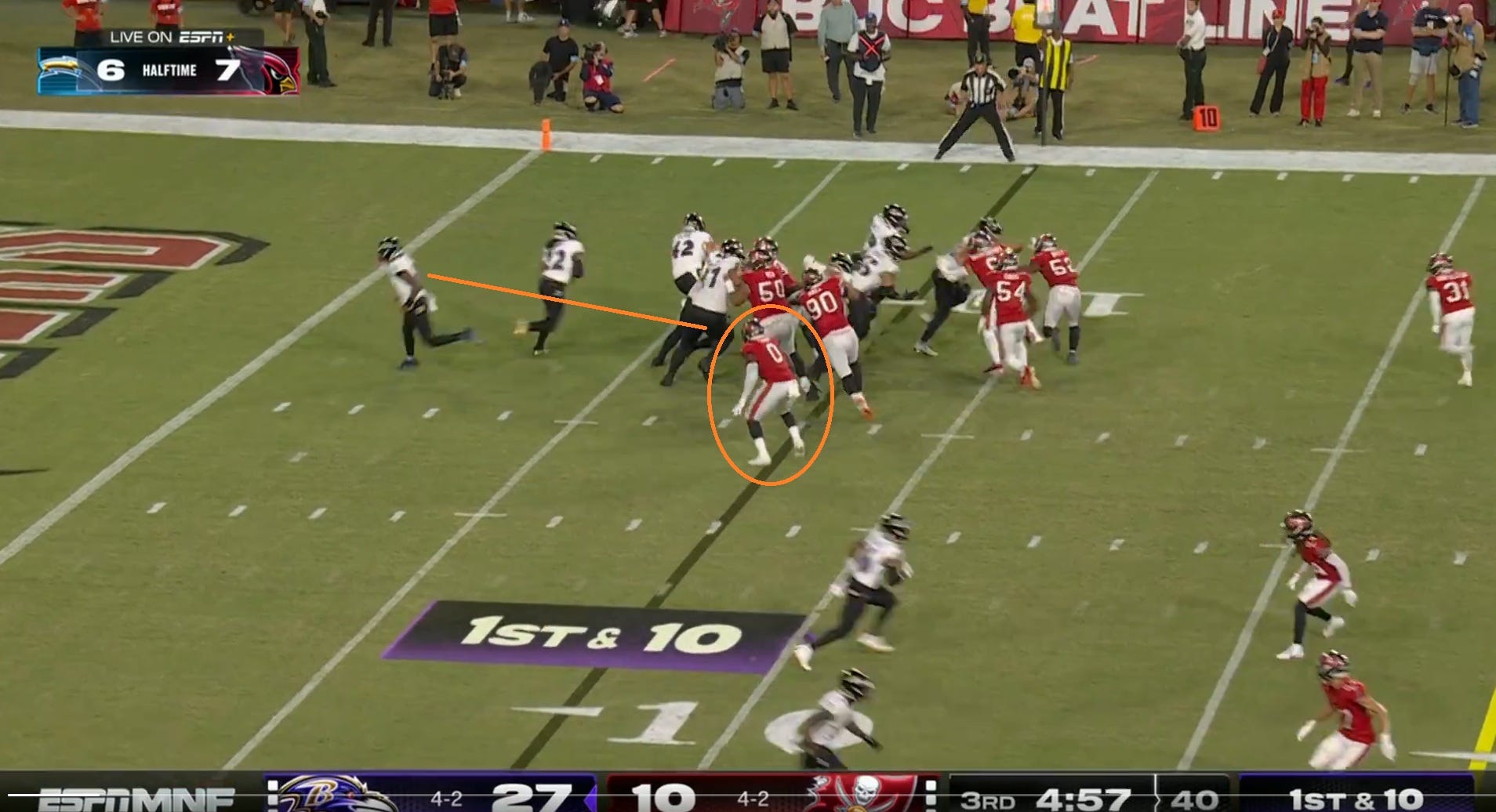
Here’s that same defender about 20 yards further downfield, trying to catch Henry:
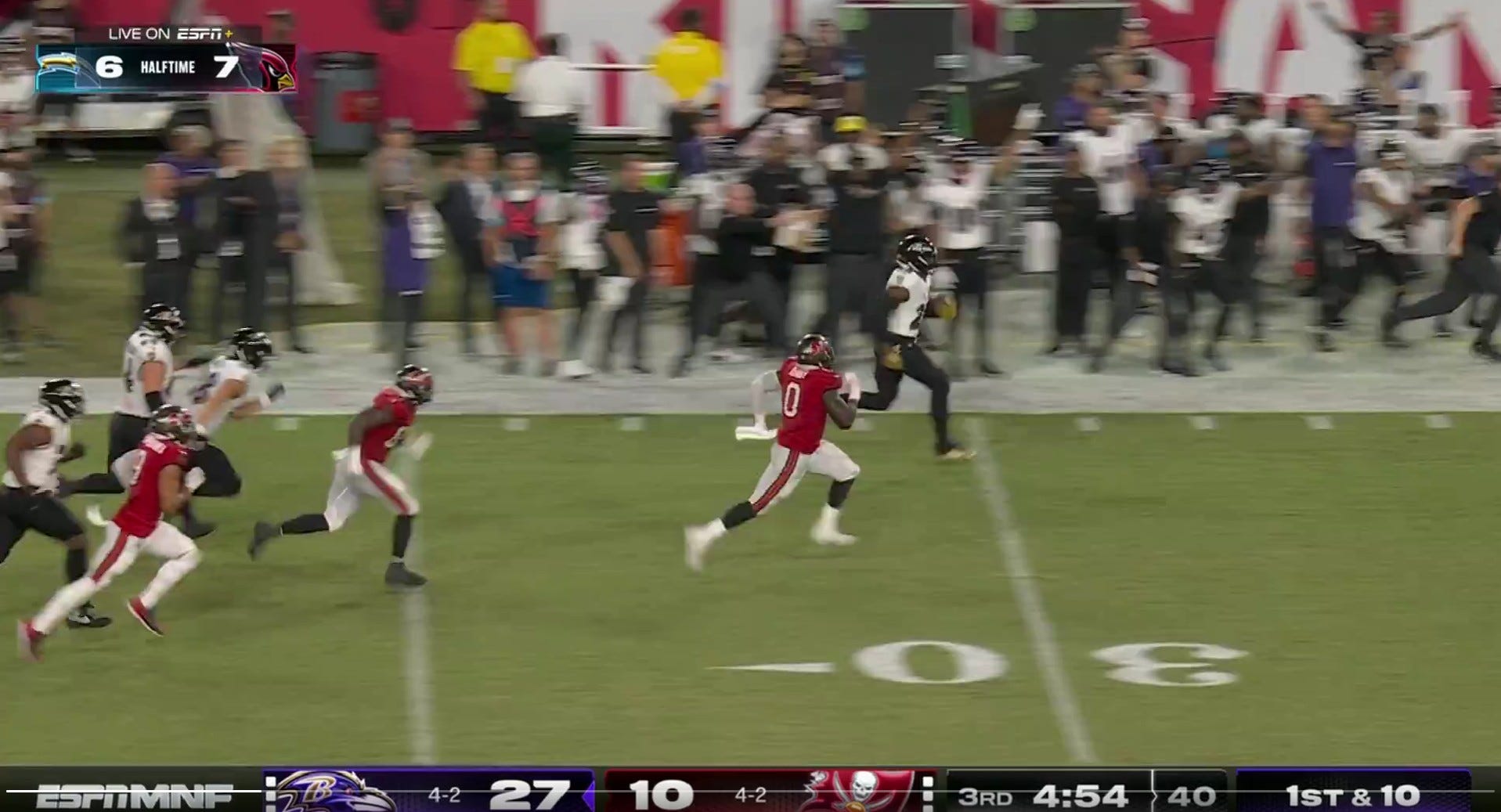
And about 30 yards further downfield:
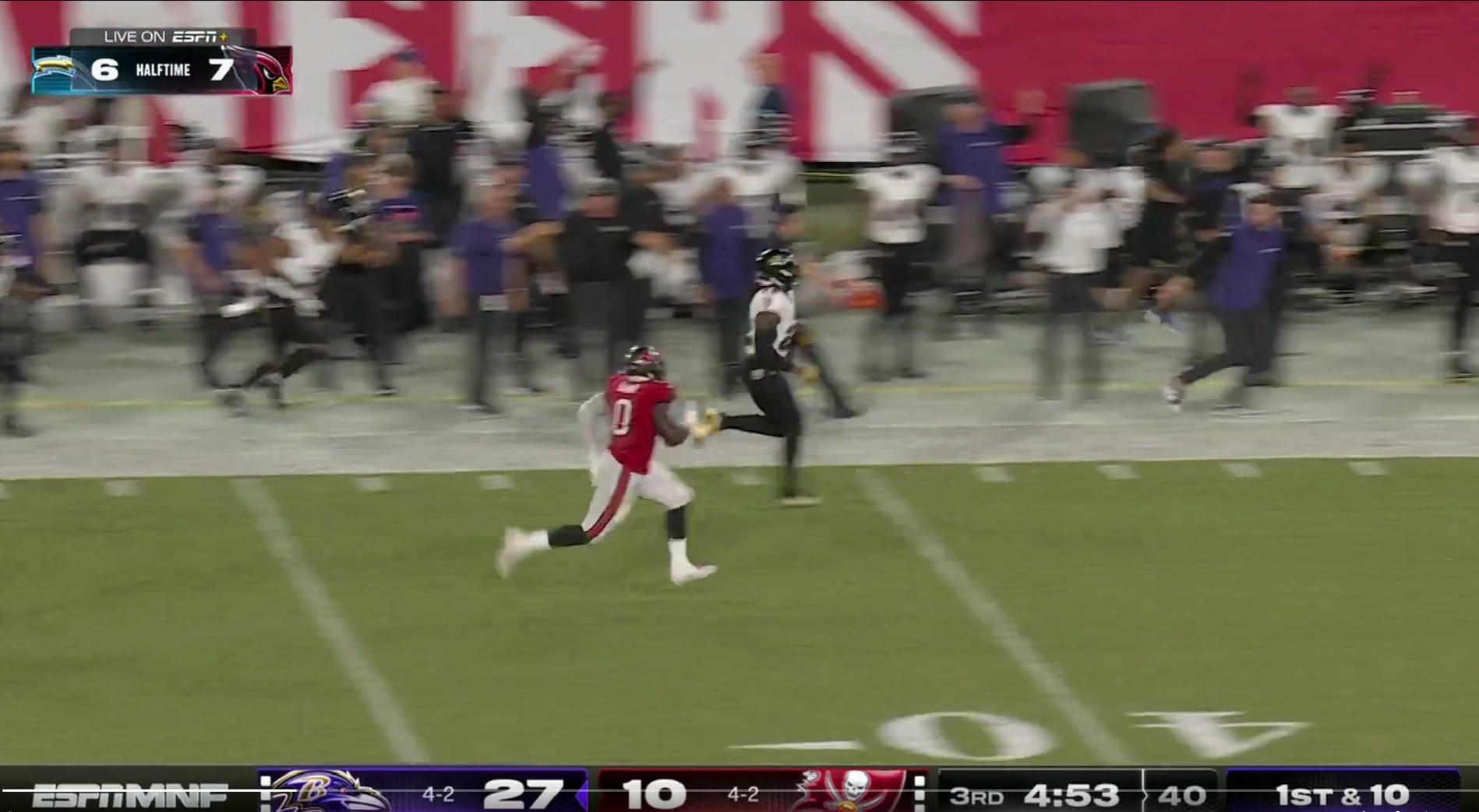
Lamar “helped” this play, right? It would’ve been a big gain without Lamar: the Ravens blocked it perfectly, and Henry made Antoine Winfield miss (or Winfield overran the play) on the front side at the line of scrimmage. But the play went for 81 yards. Wouldn’t this defender have been in position to shove Henry out of bounds after “only” a 20- or 25-yd gain, without Lamar freezing him?
Another example from that game; Antoine Winfield is on the far left:

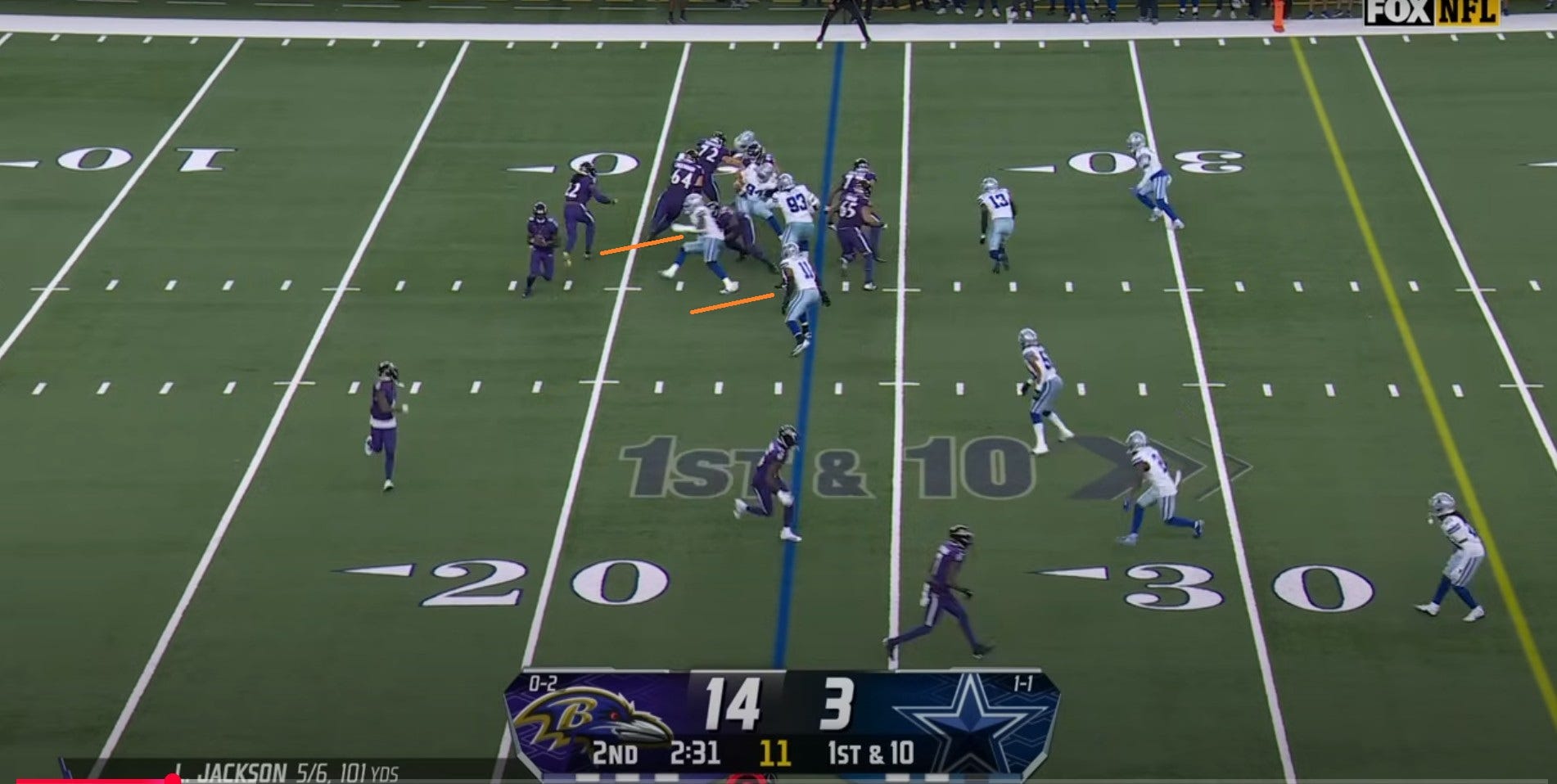
Why are defenses so reactive to Lamar? You know the answer to that. Lamar doesn’t just help Derrick Henry. Here’s Lamar helping himself, with deceptive ball-handling – and Derrick Henry off the field:

Here’s Henry about to rip off a 13-yd run vs the Cowboys; two steps after the handoff, Lamar doesn’t have the ball but two Cowboy defenders are double-checking to make sure:
Here’s Henry about to pick up a dozen vs Washington Team Football; two or three steps after the toss, Lamar doesn’t have the ball but he still has two defenders:
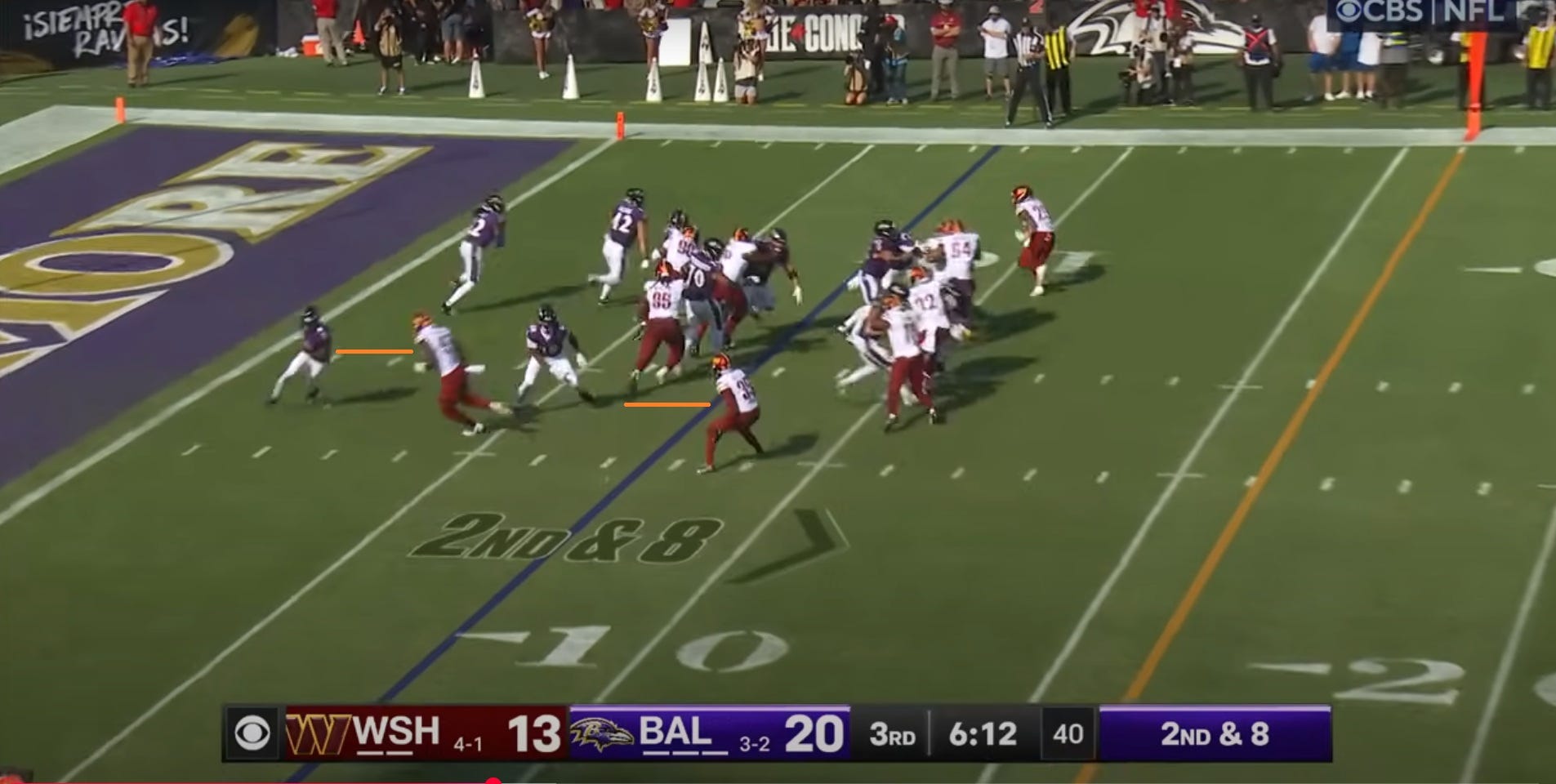
Big number 95 goes on to shoulder check Lamar anyway. Also from that game is the below clip; before the snap the corner on the far left is positioned just about exactly where Henry will come with the ball:

This kind of stuff is all over the Ravens offensive tape this year.
Now, I’m not trying to ascribe every single yard Henry gained as being “due” to Lamar. Derrick Henry has never needed much in the way of “help”. He’s enormous, he’s powerful AF, he has elite contact balance, and he has unbelievable long speed. He established himself has a Hall of Fame Running Back long before he signed with the Ravens.
But a little help goes a long way with Henry. A little defender confusion can turn a 5-yd gain into a 12- or 20-yd gain; a 20-yd gain into an 80-yd gain. Over a full schedule that can accumulate to turn a 1200-yd season into a 1900-yd season.
An aside on Henry’s big run vs the Bills to open game 4
True-blue Bills fans will think this is all bullshit. They have good reason. If they watched every Bills game, and only caught the Ravens when they played Buffalo, then those fans know in their heart that Henry carried Lamar. They saw it with their own eyes. When the Ravens played the Bills in week 4, on the Ravens first offensive snap of the game Henry blasted for an 87-yd touchdown. Lamar didn’t open any gaps by drawing defenders; Henry just took it the distance.
Those fans are right and wrong. It’s true that Lamar didn’t open any gaps for Henry. Instead, the Ravens coaches caught a tendency of the Bills defense against run plays with 2 TEs deployed to one side of the offensive formation:
In a prior game, against the look the Bills had the DTs penetrate and the MLB crash. The Ravens coaching staff countered with great scheme and tactical play-calling. They called a play to let those players come forward and then trap-block them, resulting in this alley:
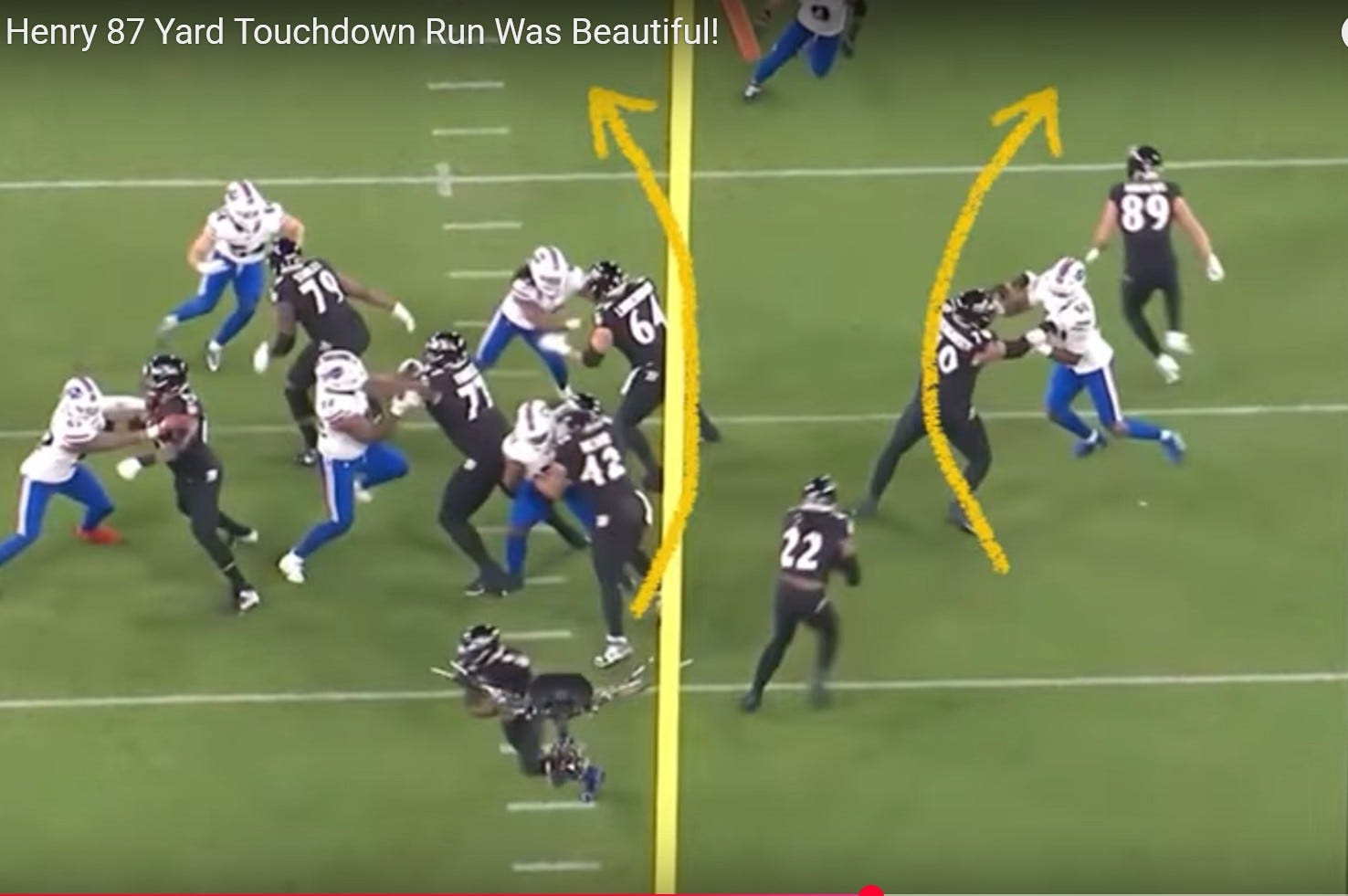
Mark Andrews is going to get the safety, and Henry has smooth sailing.
This is a 15- or 20-yd gain for any RB in the league. With Derrick Henry, his great long speed takes it the distance, and that’s awesome: but we wouldn’t say that he “made” this play. I wouldn’t even say he’s the only Ravens back that would’ve taken this to the house. Justice Hill is faster than Henry; he ran 4.4 in the 40 at the Combine. (Keaton Michell is still faster, 4.37 in the 40, but of course he wasn’t healthy for that Bills game.) 3rd-string RB Rasheen Ali might have had a chance, with his 4.45 speed.
– In stats
What records require
I mentioned above that Derrick Henry had already established his Hall of Fame credentials before signing with the Ravens. His 1900 yards in 2024, and whatever he goes on to do, is icing on the top of his HOF sundae. Before 2024, Henry’s career shape was similar to Earl Campbell’s, and he was already spoken of in hushed tones as an historically great back.
Bill James made the observation decades ago that records are set when the environment is right for them. The way I like to phrase that is that records only happen when great talent meets great opportunity. Maybe I should use the word “setting”: great talent meets great setting. Some examples:
Jerry Rice sets the career receiving yards mark. He himself is great; and he plays for the greatest pass-game designer & game-planner of his generation, probably of all time, with not one but two HOF Quarterbacks.
Rice ain’t settin’ no career records with Kyle Boller throwing him the ball.
Emmitt Smith sets the career rushing yards mark. He himself is great; and he plays for an Offensive Coordinator who believes in using a workhorse back, and he runs behind the O-line of the ‘90s Wowboys, possibly the greatest offensive line in NFL history.
Lamar Jackson sets the single-season QB rushing mark. He himself is great; and he plays for the foremost exponent of the running Quarterback of any Offensive Coordinator in NFL history.
Lamar isn’t setting that record if he’s drafted by the Patriots and sits for a year behind Tom Brady, leaning offense from Bill Belichick and Josh McDaniels. He’s not setting that record if he’s drafted by Andy Reid.
Babe Ruth sets the career home run record. He himself is great; and he’s a left-handed hitter playing his home games in Yankee Stadium, with its short porch in right (314 feet).
Hank Aaron breaks the career home run record. He himself is great, and he keeps himself in phenomenal shape to have great longevity; and he plays most of his home games in Milwaukee’s County Stadium, a little band box with short porches both right and left (315 feet).
Of course the great setting isn’t enough. Lots of other players were on the Yankees, and didn’t set the home run record. Lots of players went thru Country Stadium and didn’t break the home run record. Justin Herbert plays for Greg Roman right now, and he won’t be coming close to the single-season QB rushing mark. Or even half of it. Bill Walsh had a lot of Wide Receivers who didn’t do what Jerry Rice did.
And the great talent alone isn’t enough. We already broke our hearts imagining Jerry Rice catching passes from Kyle Boller. Remember Steven Jackson battering his way behind shitty O-lines in St Louis, playing for Jeff Fisher et al? Man, there’s a RB who deserved better.
Point is: when you see a record, or a Hall of Fame career shape, or even a league-leading performance, you can automatically assume that you are looking at a great talent AND a great setting conducive to that talent shining. Both things are true. There are damn few exceptions to this.7
The stats
Before Derrick Henry signed in Baltimore, he’d already had a 2k season and a HOF career. We all agree on that, right? The essence of the Allen-for-MVP voters’ argument was that Henry is a HOFer and deserves enough “credit” for the Ravens offensive performance that it detracts from Lamar’s “value”.
And we know from the previous section that Henry must have been operating in a great setting, conducive to him showcasing his great talent. A HOF career requires both great talent and a conducive setting.
So okay: if Henry’s previous team provided a great context for him to showcase his talent: then how is it that in 2024 Derrick Henry posted the highest yards-per-carry of his entire career?
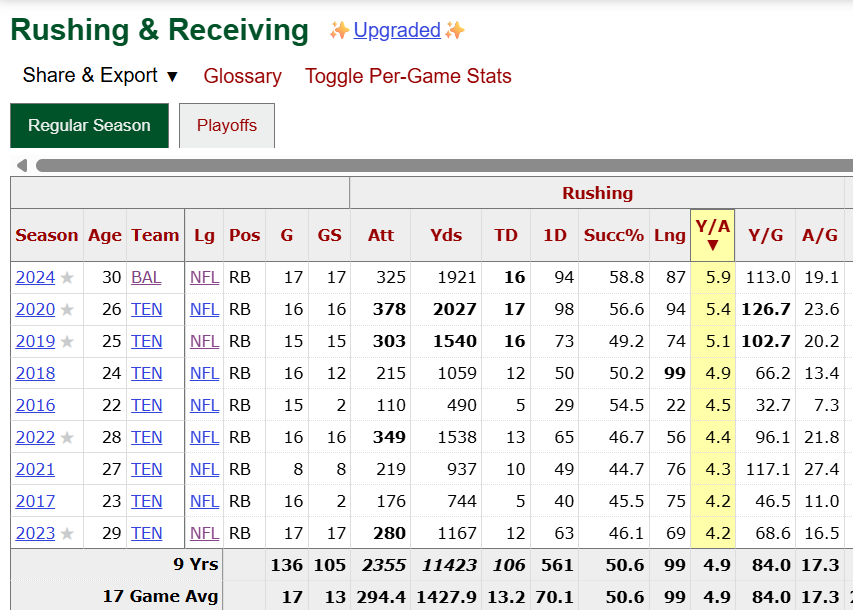
How is it that in 2024 Derrick Henry posted the highest yards-before-contact per carry of his career? He had almost double the yards-before-contact from the previous season (1012 compared to 566).
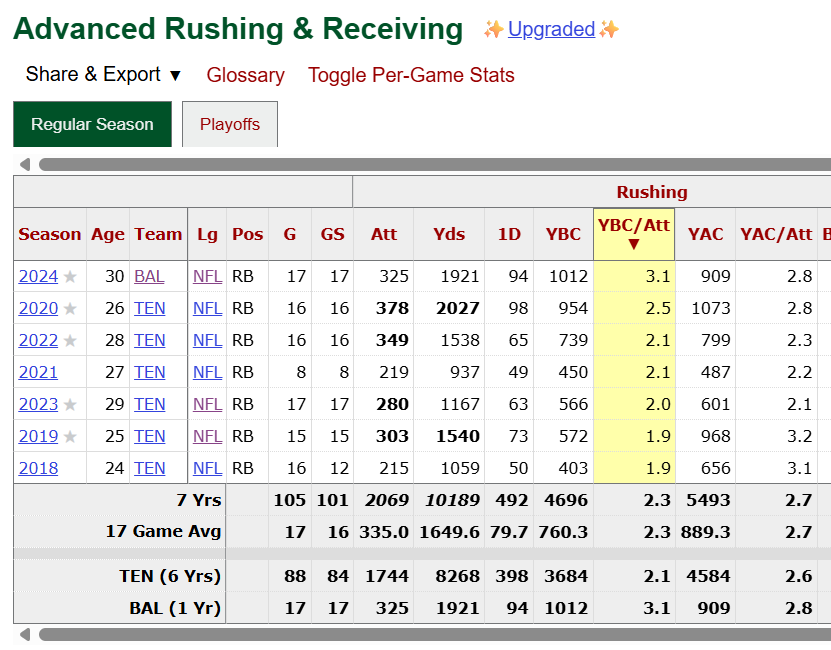
The answer is obvious. Derrick Henry’s prior “context” was good enough for him to craft a HOF career; but sharing the backfield with Lamar Jackson provided a better context. Sharing the backfield with Lamar does more for a Running Back than the previous context where Derrick Henry established his Hall of Fame credentials. Henry had 20% more yards-before-contact per carry in 2024 than he had in his 2k season!
Meanwhile Gus Edwards, who finished his time in Baltimore as the #7 rusher this century in career rushing Success Rate (min 50 carries) at over 57%, was with the Chargers in 2024 and posted his first season with Success Rate below 50 (barely). JK Dobbins was right behind Edwards at 56.8% rush Success Rate during his time in Baltimore; he also posted his first season below 50, at 42.6%.
I’m sorry, this is a slam-dunk argument ender. I was going to dive deeper into stats, but yards-before-contact being better than a HOF career just slays.
Mic drop.
Pass game
After the season, a stat circulated that, among all QBs, Lamar’s receivers had the highest “average separation”. I can’t find the simple list (I guess it’s on PFF?), but here are two graphs were that stat is one of the axes.
Vertical axis; Lamar being at the top mean his receivers have highest avg separation:

Horizontal axis; Lamar being far right means his receivers have highest avg separation:

Mina Kimes & Dominique Foxworth had a lot to say about how this stat is not the “argument ender” that fans reacted to it as. (One reply to that first tweet says “RIP Lamar’s MVP”.) Their point is that different offenses target receivers in different ways.
Joe Burrow is right around median in this stat: I promise you it’s not because his receivers are not as good as Lamar’s. The Bengals offense is designed around Burrow throwing short passes to his great receivers in tight windows. Meanwhile, Lamar is 6th (tied) in the league for Average Depth of Target. Throwing deeper means the Ravens receivers have more time to separate. Burrow is very low in that stat; 27th, behind Mac Jones. Josh Allen is close to midrank in that stat (13th).
We’ll dig deeper into this stat and others in a later section (“Lies, Damn Lies, and”). The point here is Derrick Henry and “narrative”. We’ve said a few times that there are two types of narrative at play in MVP discussions. The first is the MVP “story” (Andre Dawson’s blank contract; Josh Allen being owed a makeup award). This is the second type, narrative as description to explain how a stat resulted from on-field play. People took that separation stat and constructed this narrative to explain it:
"Derrick Henry creates open receivers for Lamar Jackson."
The thing about this statement is, it’s something one could investigate and either verify or not. The statement is not like “God is good”: it’s falsifiable. Did Henry create open receivers for Lamar? Did he do so more than Saquon Barkley did for Jalen Hurts, or Jahmyr Gibbs did for Jared Goff, or Bijan Robinson did for whoever was QBing the Falcons, or James Cook did for Josh Allen?
Is it true?
I ain’t got the time or resources to research every good RB-QB tandem and chart plays. But the narrative made me suspicious, because Derrick Henry was not the 3rd-down back for the Ravens. James Cook is a key part of the Bills passing game, but the Ravens took Henry off the field and brought in Justice Hill on passing downs.
To test the narrative, I looked at a highlight reel of Lamar’s. From it, I extracted big plays where (a) a receiver seemed “wide open” at the catch point and (b) Derrick Henry was not on the field. I was very heavily influenced by the announcer yelling “and wide open is [blank]!" Otherwise I just tried to eyeball it.
Here are 27 plays of Lamar throwing to “wide open” receivers with Derrick Henry NOT on the field –
Actually, there’s one play that probably shouldn’t be in there. It’s the one that starts around 1:15. Lamar moves around behind the line to buy time, then launches it. I think the receiver probably was not all that “open” at the catch point. I got a little caught up and forgot the strict criteria; grabbed it because Lamar created the extra time and the open throwing window. But it’s a sweet play, so enjoy it. Just feel free to subtract it from the 27-plays count:
Looking over those plays, the things I notice are:
Good tactical coaching & play-calling
Excellent route-running at the top of the stem
Lamar keeping plays alive longer than defenders can cover.
I also spotted these two plays, of Lamar throwing to wide-open receivers with Henry on the field:
Tell me, do you credit Derrick Henry for the receivers getting separation on those two plays? Because I sure don’t.
Now, while I was surfing that Lamar highlight reel, I noticed about 3 plays where Lamar used play-action to Henry and then threw to an open receiver. I only took notice of 3; I was looking for other types of plays, and maybe I had some incentive to undercount, so the true number may have been more like 5 or so. Obviously Derrick Henry ought to be a big enabler in the play-action game. It’d be malpractice not to use him. But the count sure doesn’t support the notion that the big plays in the Ravens passing game tended to be enabled by Derrick Henry opening things up.
To be absolutely clear, I have not just disproved the idea that “Derrick Henry creates open receivers for Lamar Jackson.” But I think I’ve shown there is good reason to be skeptical of it. To me it smells like bullshit: a narrative that seems logical, but doesn’t prove true when you examine it closely. The narrative absolutely does not merit any benefit of the doubt.
The argument was a fig leaf anyway. It was never enough to overcome (1) the historical meaning of MVP, (2) the history of All-Pro caliber teammates with MVP Quarterbacks, and (3) how much Lamar helps Derrick Henry in the running game. But even that little bit of gossamer vanishes when you examine it closely.
How Derrick Henry really helped Lamar
What Henry really did for Lamar was take the rushing load off his shoulders. 2024 was the first season in Lamar’s career when he did NOT lead the Ravens in either rushing attempts or rushing yards:
The Ravens in the Lamar era have leaned far, far too heavily on him to create their rushing attack. Maybe if JK Dobbins had not gotten injured, some of those years would have played out differently, but that’s not our timeline.
And Lamar has always looked as if he’s getting run down, as the seasons have come to an end. He’s always looked a little drawn & tired.
Weight for it
We remember Bill Polians’s comments about Lamar shifting to WR bitterly, in part because we attribute them to a racist tendency. But it’s also worth remembering that Polian was an old GM and subscribed to some classical theories about QBs. No, I don’t mean the racist ones; I mean that he liked big-guy QBs. Among the QBs Polian drafted:
Jim Kelly was technically only an inch taller than Lamar and only 5 pounds heavier at the Combine; but (a) he was drafted 35 years earlier, when player sizes were very different across the league, and (b) he had kind of a blocky build to him.
Kerry Collins was 6-5, 247. Chunky!
Peyton Manning was 6-5, 230.
Matt Waldman reports (in his 2018 RSP, page 36) that Polian had a 1st-rd grade on QB Nate Davis (not to be confused with the O-lineman of the same name). When Peyton Manning messed his neck in 2011, Polian brought in Davis for a tryout. Davis weighed 226 pounds at the Combine.
Waldman also reports that Polian talked up Chad Kelly during the 2017 draft cycle: 224 pounds.
When it comes to QBs, Polian liked ‘em thicc. That’s an old-school preference. Here’s Waldman:
Jackson may have reported to the Combine at 219 pounds, but football men know that there have been players with similar builds to Jackson’s who’ve had trouble maintaining a desired weight during the season. Players who can’t add additional muscle mass are believed to have a high risk of wearing down.
There’s a difference between a 219-pound player with a wiry frame that might not hold those 8-10 pounds [all thru] the season and a 233-pound player whose build looks like it could even support another 5-10 pounds. By season’s end, this could be a differential of over 30 pounds.
Lamar was kind of spindly for a QB when he came out in the draft. Just 21 years old, so some of that was youth (see also: Nate Wiggins), but he also just didn’t have a big frame. Some football men feared that he would wear down over the course of a season; and many times over his career it looked like he had.
An option that commands respect
Baltimore of course uses option tactics heavily in their run game.
I have always thought that when Lamar is at the mesh point with a Running Back, usually there must be the idea in the back of his mind that he could gain more than the other guy. Nine times out of ten he’s been the most dynamic player on the field; and of course he knows that. So when he’s executing a read-option with Mark Ingram, or Gus Edwards, or JK Dobbins – sure as hell with Devonte Freeman, Latavius Murray, and Kenyon Drake – Lamar must have the idea in the back of his mind that keeping the ball would not be a bad idea. Don’t you think?
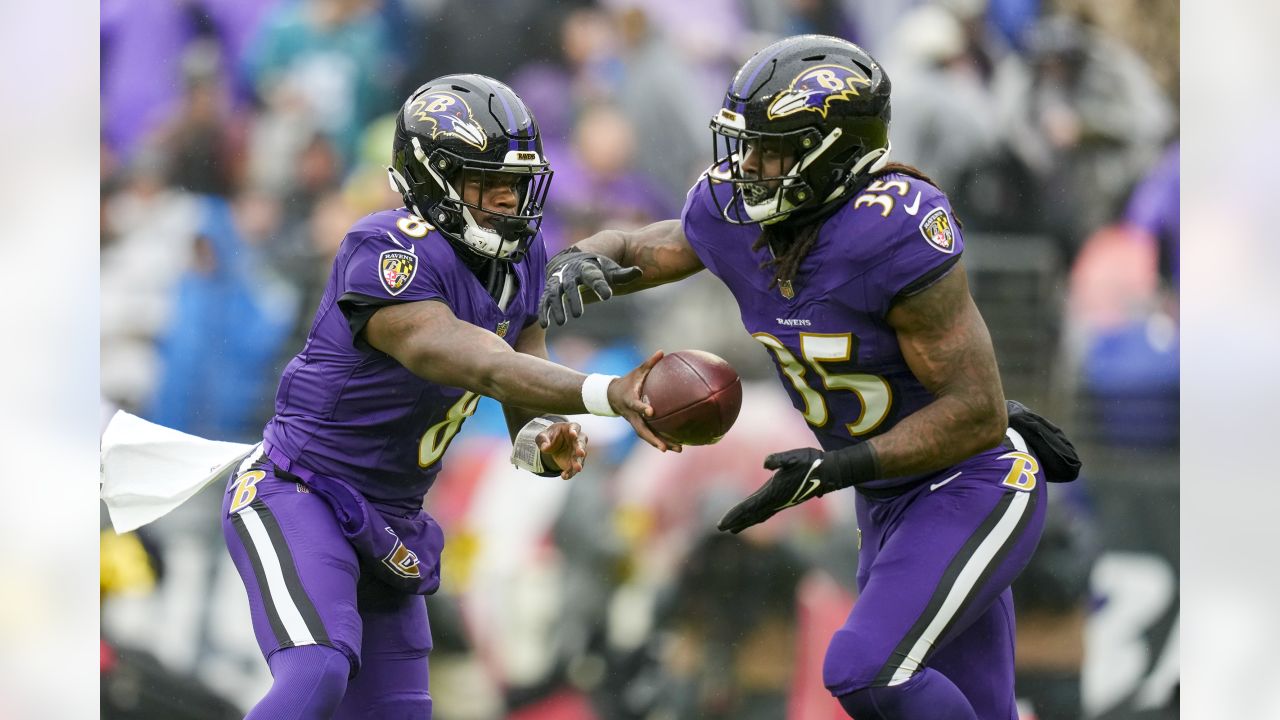
Defenses can give the offense a “give” read and a “keep” read. They can be keying on the QB at the mesh point, in which case the proper read is to give. Or they can be keying on the RB, so the proper read is the keep. But with most of the backs Lamar has played with in his career, I bet that even when the read is a “give”, Lamar must have the idea in the back of his mind almost every play that he could keep it and do more than the back could. He could make magic even if the read is not indicated.
Hell: in the 2019 game against the Patriots, there’s an insane play on the goal line where the proper read was the “give” to Edwards, Lamar screwed it up and kept, took one step, immediately realized he was wrong – and turned to follow Edwards thru the hole! Lamar just used Gus as a Fullback and ran into the end zone. Cris Collinsworth on the call was laughing his ass off. He said it’s not often you see an option QB make the wrong read and then turn to follow the RB into the gap for a touchdown.
Point being, before the 2024 season Lamar has always known, deep in his bones, that he was a better runner than the back he was sharing the mesh point in. I mean, I’m just guessing: but don’t you think that’s true?
Enter Derrick Henry.
The 2023 Ravens lost the AFC Championship Game to Kansas City, and one of the accusations after that game was that the coaching staff had abandoned the run. Gus Edwards had lost fumbles in consecutive games to close the regular season (Miami and Pitt), and I think the staff lost faith in him – at the worst possible time.
Enter Derrick Henry.
Derrick Henry commands respect from everyone in the building. If you’re a play-caller, you don’t forget you have Derrick Henry. In a neutral game situation, I bet you don’t go four consecutive plays without going, “Let’s give the big guy another carry.” And if you’re Lamar Jackson at the mesh point, in the back of your mind you’re not saying “I’'m a better runner than that guy.” In the back of your mind you know, “That’s King Henry!”
That’s why you pay free agent dollars to a 30yo Henry instead of a younger back. There were other good backs available. But Derrick Henry has gravitas. He commands respect. He has a mental impact on the coaches and the Quarterback that no other QB does. Not even Saquon Barkley. Barkley is younger, and obviously a tremendous, tremendous player: but he didn’t have the career accolades that Henry had. He wasn’t King Henry. Derrick Henry changes your habit of thinking, whether you’re a play caller or the guy making the option decision at the mesh point.
Closing
Here’s Lamar’s career rushing attempts per game:
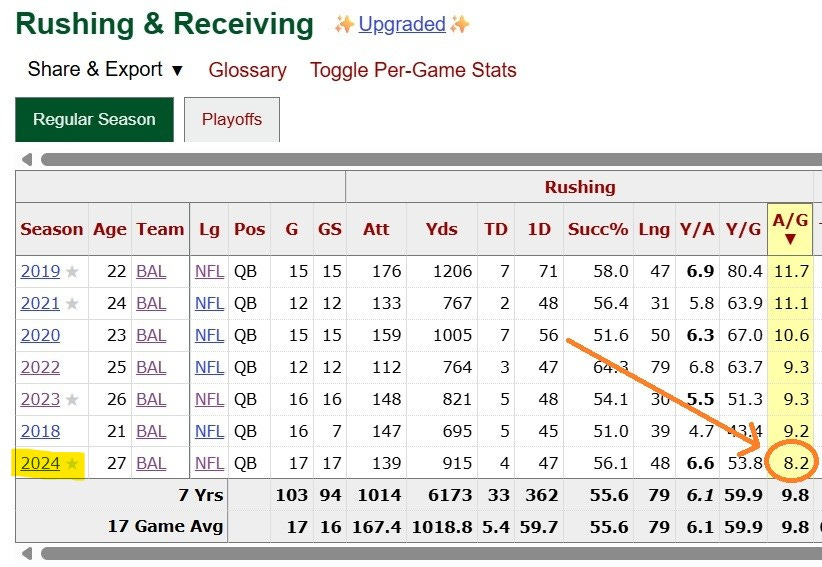
This is the biggest way Derrick Henry helped Lamar Jackson. He helped keep Lamar fresh for the end of the year. When the Ravens had a lead and it was time to close out the game, Lamar didn’t have to make those rushing first-downs happen. Give it to the horse. Let the big dawg eat.
Derrick Henry has been the very definition of a workhorse back thruout his career. That means Lamar didn’t have to be the workhorse. And to my eyes it worked. Lamar looked fresher toward the end of the season than I’d ever seen him before. It was a tremendous addition. Didn’t quite translate into the postseason run that we all wanted, but there’s still no arguing that it was a great move.
I think Lamar has leaned even more this offseason into what having King Henry means. Many observers commented during minicamp that Lamar looks like he’s lost more weight this year:
He’s more comfortable being smaller (and faster) than he’s been in five years. We’ll see what that translates to: but it further illustrates that how Derrick Henry really helped Lamar was not by drawing attention in the run game or opening things up in the passing game. How Derrick Henry really helped Lamar was by being the workhorse so Lamar didn’t have to lead the ream in rushing. Again.
A game Josh Allen wins
A mental game I play sometimes, and I bet you do too, is to hypothetically switch Quarterbacks on teams and theorize about who would be better or worse. For example:
— If you swapped Lamar and Joe Burrow between the Ravens and Bengals, who would benefit?
Analysis: Lamar could throw to Ja’Marr Chase and Tee Higgins as well as Joe Burrow can – hell, it would probably feel like a vacation compared to the receivers he’s had to work with for most of his pro career – and Lamar would boost the Bengals running game. Whereas, the Ravens run game would decline slightly. Some receivers would do better – I bet Rashod Bateman would put up a zillion yards with Burrow – but Mark Andrews would lose the QB he has the telepathic connection with. Mixed impact on pass game, negative impact on run game.
Verdict: Bengals would be better, Ravens would be worse.
I play this game with most of the MVP-list QBs most seasons. (Not years when Lamar has gotten hurt.) Lamar for Brock Purdy on the Niners? Kyle Shanahan would go insane with Lamar. (Good lord, C-Mac with Lamar?? Yeesh!)
Lamar even comes off decently swapping him for Mahomes. Obviously not even I will claim that some other version of the Chiefs would’ve done better than 5 Super Bowl appearances with 3 wins. In my scenario, Lamar would be somewhat better playing for Andy Reid’s staff from Day One as a pro, Mahomes would be somewhat worse laboring for Marty Mornhinweg and Greg Roman from Day One, and overall the Chiefs & Ravens would do about the same as they have in real life.
Laugh at my over-the-top Lamar-ism all you want, but the point is this:
Josh Allen is the one Quarterback where I think the swap hurts the other team, no question.
If the Bills played in, say, Tampa or Indy I’d feel differently. But they have to win in Buffalo in December and January. They need the “all weather tires” that Josh Allen’s arm-cannon & size gives them. Even the times when Josh Allen has been (used to be) erratic and given to YOLO balls, his ability to throw it thru a brick wall gives the Bills an element that their home environment demands. PFR says that one of Josh Allen’s nicknames is “The Winter Soldier”. Awesome nickname: and it perfectly captures what I’m saying.
— If you swapped Lamar and Josh Allen between the Ravens and Bills, the Bills would be worse. The Ravens might be worse too – that trade could easily hurt both teams – but the Ravens would stand a better chance of being about the same than the Bills would.
Josh Allen might be the best possible QB for Buffalo. That’s important. It doesn’t make him league MVP or anything, but it has real value.
The Supporting Cast
Josh Allen voters say that Lamar's teammates on offense are much better than Josh Allen's. Allen is playing with the Little Sisters of the Poor, while Lamar is throwing to the Greatest Show On Turf receiving corps.
This argument is overblown and embellished to make Allen look better.
By the way: that term “supporting cast” is kind of crappy, isn’t it? Implies one player is the lead actor, and everyone else is a co-star. You think Zay Flowers’ mom thinks her baby isn’t the star of the story? Derrick Henry is a Hall of Famer: is he not a lead actor? Ronnie Stanley and Mark Andrews have been 1st-team All-Pro in their careers. A term I like better is “surrounding talent”. But everyone in this discussion uses the term “supporting cast”. I dunno, maybe that makes sense in the MVP analysis. By definition you’re searching for THE lead actor of the NFL season. I have reservationsm, but I guess:
Remember that no one last offseason thought the Ravens WR group was particularly dangerous. Zay Flowers had finished his rookie season ranked 77th in yards-per-target and 53rd in Success Rate. Rashod Bateman had finished 2023 ranked 128th in the league in yards-per-target and 100th in Success Rate. He entered 2024 having averaged 390 yards-per-season over his 3-year career.
Meanwhile Buffalo’s Khalil Shakir led the league in Yds/Target in 2023 (among eligible players) with 13.6; and in Success Rate. Gabe Davis finished 37th in Yds/Target. Shouldn’t the conversation going into 2024 have been how much better and more established Buffalo’s WRs were than Baltimore’s?
(That column YTS is the product of the two columns before it; "NFL Rank" is by YTS.)
Buffalo traded away Stefon Diggs last offseason, taking on “the largest non-QB dead-money hit in NFL history ($31M),” because they thought it was addition by subtraction. Shakir and Gabe Davis fit better in new Offensive Coordinator Joe Brady’s scheme, and they weren’t high-maintenance divas like Diggs.
Why are we just uncritically accepting the idea that Josh Allen’s supporting cast was so much weaker than Lamar’s? Before the season, every indication was that Buffalo’s “supporting cast” was better:
Bills WR Khalil Shakir led the league in both Yds-per-Target and Success Rate
Bills WR Gabe Davis finished top 40 in YTS
The Ravens had only one returning WR who cracked the top 50 in YTS, and he was a reserve
Bill RB James Cook made the Pro Bowl
Tenn RB Derrick Henry had his lowest Yds-per-attempt and Success Rate since he’d become a starter six years earlier.
Derrick Henry turned 30 that January, and most people thought he might be washed. Heading into 2024, Buffalo had a more accomplished pair of starting WRs, a better RB (Pro Bowler vs a probably-washed 30yo), and a better Offensive Line. Yes, the Ravens Tight Ends are better – Baltimore probably has the best TE depth chart in the league – but overall the Bills offensive personnel looked like they were better.
It was only after Lamar started lighting up the league that people reframed Josh Allen’s supporting cast as being a buncha JAGs.
Now, I am a big fan of both Rashod Bateman and Zay Flowers. I think they both have significant upside – still have upside, in the case of Bateman. Both were 1st-rd picks. If a Bills fan were to assert that Bateman & Flowers have higher upside than Khalil Shakir & Gabe Davis (picked in the 5th and 4th rds), I would not argue. I’d rather have the next 5 years of Bateman & Flowers than of Shakir & Davis & Mack Hollins. But going into the 2024 season, Shakir & Davis were more established & accomplished players. And this would be a good place to reference that lost clip, of Dan Orlovsky saying the Bills WRs were good enough for Josh Allen to win MVP.
By the way, Lamar’s receivers finished with a Drop Rate 42% higher than Josh Allen’s receivers: 6.1% to 4.3%. Why O why are we uncritically accepting this idea that Lamar’s receivers in 2024 were much better than Josh Allen’s?
(Lamar still finished with a higher Completion% and a higher Success Rate: more detail in the traditional stats section, way below.)
Back around January 1, Mina Kimes did a thoughtful look at “the MVP race” with Dominique Foxworth on her podcast. Starting at about 31:55 they talk about the different supporting casts between Joe Burrow and Josh Allen and Lamar:
The discussion is well worth listening to. I especially enjoy Mina dunking on the idea that Lamar has this super outstanding WR corps. They eventually land on:
Joe Burrow has by far the best WR corps (duh)
Lamar has the best Tight Ends (again, duh)
Lamar has the best RB, but it’s surprisingly close; James Cook is right next to Derrick Henry in DVOA.
(Cook actually ranked ahead of Henry, 2nd vs 4th, in EPA per play among running backs with 200+ touches this season. Henry still led yards per touch 6.1 vs 5.2. )
Josh Allen has by far the best Offensive Line among the three QBs.
I think that’s the most fair overall assessment of the “supporting casts”.
This year (for 2025) Brandon Thorn has the Bills as one of two “Elite Offensive Lines” in his OL rankings. It’s the same five starters as last season. Thorn writes:
They are led by an elite tackle duo in Dion Dawkins and Spencer Brown, a rock-solid interior trio, and a top-tier line coach in Aaron Kromer. The Bills also have quality depth, including Alec Anderson, who was an impact sixth lineman.
Thorn did not have them rated that highly going into last season (the piece is paywalled, so I don’t know just how high he had them), but I assume they were rated as pretty good. Certainly this year’s rating wouldn’t be as high if they weren’t damn good last year.
The Bills OL was particularly good – and the Ravens OL was particularly unsettled! Left Tackle Ronnie Stanley returned to something close to his former All-Pro form (and made the Pro Bowl), which is an unbelievably welcome development. Center Tyler Linderbaum made his second straight Pro Bowl. But the other three were first-time starters at the position:
Right Tackle Roger Rosengarten was a 2nd-rd rookie, skinny for a starter
Left Guard Patrick Mekari was a career backup utility O-lineman
Right Guard Daniel Faalale was a first-time starter
And the Ravens longtime OL coach, the beloved Joe D'Alessandris, friggin’ DIED during training camp.
By the way — Am I crazy, or is the O-line coach the 3rd or 4th most important assistant on a staff? There’s the Offensive Coordinator, the Defensive Coordinator; and then the OL coach, right? Maybe the QB coach: he could or could not be on par with him in importance, depending. When you think of NFL dynasties, often an OL coach is an integral part them. Joe Gibbs’ Redskins had Joe Bugel. The Bill Walsh Niners had Bobb McKittrick. The Mike Shanahan Broncos had Alex Gibbs; not quite a dynasty in their own right, but the Shanahan-Gibbs system became probably the most influential offense in the league. The Belichick-Brady Patriots had Dante Scarnecchia. We fans don’t accord OL coaches the same “star” treatment we give to hotshot Offensive Coordinators, but maybe that’s a big mistake.
Anyway – that’s a crazy amount of turnover. The Ravens were able to bring in an experienced coach on an emergency basis, George Warhop, and he seems to be good. To my eye that unit improved all season long. I expect good things from them this year.
But let’s not pretend the O-line was a particular strength for the team last year. Rosengarten looks to me like he’ll develop into a 10-year cornerstone, but he took his rookie lumps early. Mekari was technically sound and knew the game plan, but not a plus athlete. Faalale is –
Well, Faalale’s an unusual player. He’s enormous, at 6-8 380. Also he’s ponderous and slow off the snap. Typically if he gets his hands on a pass rusher, that guy’s pass rush is over; but defenders were crossing Faalale’s face and beating him off the snap a lot last season. A very common sight was a defender blasting thru the A-gap immediately, and Lamar having to sidestep and create time for himself. Lamar being Lamar, he made that look routine, and I think many of those plays were not recorded as “pressures”. Faalale was even named a Pro Bowl alternate, somehow! But I wouldn’t decribe Faalale as being a particularly good Right Guard, or reliable. He had great strengths the Ravens were able to leverage, and great weaknesses the Ravens were able to minimize (primarily thru Lamar’s great gifts).
I suppose I have minimized the Tight End position. Let’s cover it.
Mark Andrews + Isaiah Likely + Charlie Kolar is probably the best TE group in the league. I think Kolar could start for many teams; for the Ravens he can barely get on the field. Baltimore will probably let Mark Andrews walk in free agency next year; a former All-Pro and certain Ring of Honor member. They can make that move because of how good Likely is.
At the same time, the Bills have Dalton Kincaid, who was their 1st-rd pick in 2023 and gained 670 yards as a rookie. Their 2nd TE is Dawson Knock, a 3rd-rd pick in 2019 who made the Pro Bowl in 2022.
The TE group is a strength of the Bills team. Also, Mark Andrews didn’t start the season well. He was not on the injury report; but I think the Ravens were pulling a fast one, and he was in fact hurt. He had been in a car accident in August. He did not look good at all for the first 4 weeks of the season. After that, Andrews turned it on
So: yes, the Ravens are better at TE than the Bills. But how much better? Does it matter that the Ravens #3 TE is good, if the #3 TE never gets on the field? Is Mark Andrews that much better than Dalton Kincaid if Andrews is hurt the first four weeks of the season?
Wrapping up:
Josh Allen supporters are shading the truth about Josh Allen's supporting cast. Most notably with the OL, 2nd-most with the RB; but also with Dalton Kincaid vs Mark Andrews, and the comparison of Flowers/Bateman/Agholor vs Khalil Shakir / Gabe Davis / Keon Coleman / Mack Hollins / Amari Cooper. The Ravens have a couple WR2s who can operate in space, but could really use a Keon Coleman -style winner-at-the-catch-point WR.
(And they may have signed one for this year in De’Andre Hopkins!)
Overall, going in to 2024:
        OL: Bills way better
        RB: Ravens slightly better; much closer than popularly understood
        WR: Mixed. Ravens higher upside, Bills more established
        TE: Ravens better, but Bills very good, and Andrews possible injury wks 1-4
These supporting casts are much, much closer than is commonly argued. And if the Ravens overall were better, there is no way the Ravens supporting cast was ENOUGH BETTER than the Bills supporting cast, to offset the enormous difference in productivity between Lamar and Josh Allen.
Josh Allen did not “do more with less”. Whatever he did, he did with “about the same”.
Re-litigating the 2023 MVP award
One thing that is said – not so much out loud by voters, this mostly comes from fans – is that the 2024 MVP award is a fair and just makeup call for the 2023 award. It’s kind of crazy that we have to relitigate 2023, but here we are.
The notion that Josh Allen deserves the makeup call depends on two ideas:
Lamar should not have been the 2023 MVP
Josh Allen was the right alternative
You see? Both have to be true. It’s not enough to say that Lamar wasn’t the guy, you also have to show that Allen was.
I have no problem with the idea that Lamar was not an obvious or runaway MVP in 2023. I mentioned Scott Kacsmar above, the snarky member of the Pro Football Writers Association. Toward the end of this past season he wrote about Lamar’s 2023 MVP that it was a “default MVP”:

That’s something I might’ve got mad about at that at the end of 2023.8 With hindsight I can see what he’s saying. None of the major MVP candidates sustained an outstanding case all season long. Tyreek was on pace for 2,000 yards receiving, which has never been done; but he fell off the last 5 weeks. Christian McCaffrey probably had the best statistical year: led the league in rushing with 1450 and had 2,000 from scrimmage. But voters are skeptical of RBs winning MVP now. Dak Prescott had the best stats among the QBs, 4500 yards with 36 TDs / 9 INTs. But I think the Cowboys were perceived as having backed into the division title, with Philly imploding.
In this way, Lamar’s 2023 MVP is not unlike Peyton Manning’s 2008 MVP.
The 2008 MVP
Most seasons, the MVP is blindingly obvious. Peyton throws 55 TDs? Obvious MVP. Brady throws 50 TDs? Obvious MVP. AP rushes for 2100 and drags Christian Ponder to the playoffs? Obvious MVP. LDT sets the record with 28 rushing TD while his Chargers lead the league in scoring and capture the top seed? You may question whether a RB should win MVP, but there’s an obvious MVP case. Lamar’s 2019 MVP is like that. Lead the league in TD passes and set the QB rushing record with 1200 yards: obvious MVP.
But Manning’s 2008 season was not like that. If you throw Manning’s stats on a slide with the other candidates, it would be hard to pick the MVP winner’s stats out of the lineup. Here’s everyone who received a vote for MVP that season:
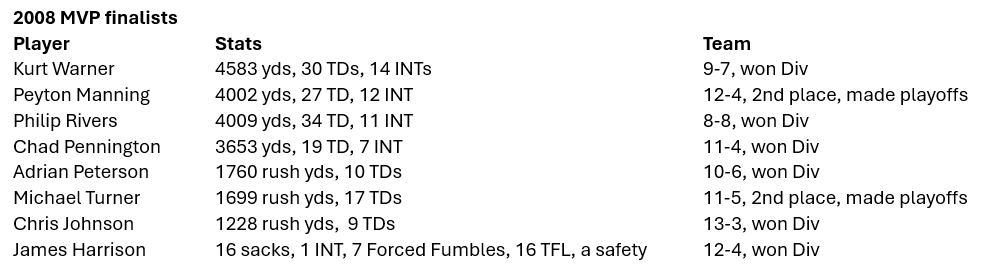
Yeah, I changed the sort to mess you up a little. 🙂
If you were scrolling thru seasons and landed on this list, would you pick Peyton as the MVP here? Statistically it looks like Warner or Rivers, to me. Manning’s team has the most wins of the QB candidates, so there’s that. Three Running Backs got votes. And a Pass Rusher! So that’s interesting. Suggests a possible lack of consensus, to me. Under the old voting system, you could vote for only one person (now they do ranked-choice voting), so having that many candidates seems like it might be significant. The top two RBs look intriguing here. I wouldn’t pick Harrison for MVP, but Defensive Player of the Year is certainly in play (which in fact he won that year).
Manning’s season isn’t even a very good one – I mean, for him. His previous MVP seasons, he’d led the league in passing yards and his team had won the division; or he’d set a (now twice broken) record for TD passes and won the division. This one looks kinda meh in comparison.
From a distance, we wonder why Manning was the choice that year. I don’t remember any of the narrative around MVP that season. What I remember from 2008 is rookie Joe Flacco and an amazing defense making the AFC Championship Game behind a 3-headed rushing attack, with a rookie head coach named Harbaugh. MVP? Who cares?? We might make the Super Bowl, baby!
I asked Google, “Why was Peyton Manning the 2008 mvp?” The AI overview gave me this:
…primarily because of his crucial role in leading Indianapolis to the playoffs after a 3-4 start, overcoming injuries and a struggling offensive line. Despite a weaker start to the season, Manning orchestrated a remarkable turnaround, including seven fourth-quarter game-winning drives, and guided the Colts to a 9-game winning streak and a playoff berth….
Much of that is true. Indy did start 3-4, and they did close on a 9-game win streak to take the 5th seed. PFR has Manning with 6 game winning drives, not 7, but close enough. Their starting RBs averaged only 3.5 yds-per-carry, which is very bad. Their starting RG was a rookie, their starting LT was 2nd-yr man Tony Ugoh, who was out of the league a couple years later.
So: okay, fair enough. I buy Manning as the 2008 MVP. But the point is you have to dig for it. It is not obvious from a quick statistical glance, as it is for most MVP seasons.
The 2023 MVP
In 2023, Lamar was the last man standing of a so-so group of candidates. One widespread narrative was that the QB of the team that won the Christmas Day matchup between the Niners and Ravens would get the MVP award. That turned out to be Lamar. The Ravens bludgeoned the Niners, and Lamar played out of his mind. He was brilliant, in the highest-profile setting, in a holiday game that everyone watched. He made the Niners great front-7 players look like they were ready to give up. Lamar followed that up with a perfect game against the Dolphins (literally perfect) to sew up the top seed, and that was that.
But a lot of that is voter perception. Lamar had two magnificent games at exactly the right time. What if you reordered the schedule?
This is a useful thought experiment to try when you think someone’s whole-season case may not be as good as their what’s-happened-lately case.
Say you swapped the games against the Niners & Dolphins with two losses from earlier in the season: let’s say the loss in Pittsburgh from October, and the loss at home to Cleveland in November. Then Lamar’s two magnificent games are not back-to-back to reinforce their impression. Lamar had bad stats in the two losses (he played great against Pittsburgh, the game was marred by horrendous drops from his receivers), so Baltimore would have clinched home field and then dropped their last three, with Lamar throwing 1 TD against 3 INTs and a fumble (and then sitting out the finale).
Would Lamar still have won MVP? Very possibly not. The voter perception of his 3600 yards with 24 TDs would have been very different. Certainly Lamar’s season as a whole was not obviously at MVP level. The Ravens offense was shaky to start the season; they didn’t really coalesce until around game 7. Their defense was spectacular, but that’s not an argument for a QB to win MVP.
So, we Ravens fans can at least tentatively grasp the concept that maybe Lamar was not the obvious and indisputable choice. We don’t love the idea, but we can stipulate it for argument’s sake.
But that leaves a problem for Josh Allen supporters. Here’s the voting for the 2023 MVP award:
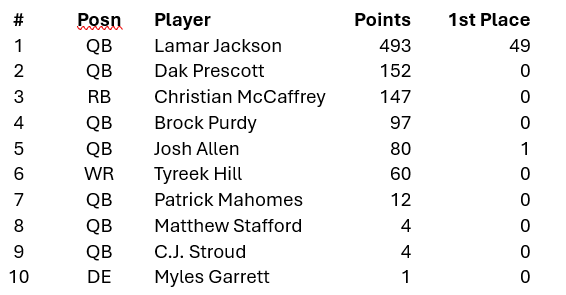
If Lamar doesn’t get the 2023 MVP, it does NOT automatically fall to Allen. In fact, Josh Allen finished 5th in the voting! Here’s a similar table to the one I did above for 2008, everyone who got a vote for MVP, again with an unusual sort:
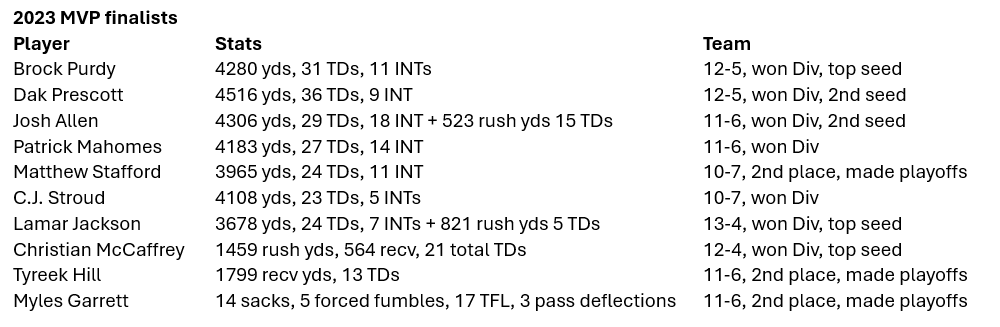
The sort is by aYTS for both lists, if you’re wondering.
Again let’s play the game of, if you were scrolling thru seasons in a record book or something, and landed on this list, who would jump out at you as the probable MVP?
At a quick glance, Purdy and Prescott “look” like the probable MVPs to me, though Josh Allen’s & Lamar’s rushing numbers make me want to take a second look. Also C-Mac’s scrimmage numbers make me want to dig a little. Allen’s 18 INTs is a big number compared to his peers; a potential red flag. Digging into the Bills Touchdown log for that season, I see that Allen had five 1-yard TDs, two 2-yarders and a 3-yarder. In other words, more than half his TD runs look to be “vultured” off a teammate. Not an MVP credential, in my estimation.
So that leaves me with Purdy and Prescott, and possibly C-Mac. Lamar probably would not make my top 3, from a quick scan of the stats.
Lamar’s 2023 season did not include as much adversity as Peyton Manning dealt with in 2008. But there is the similar theme of him dragging an offense thru force of will, and finishing with unimpressive statistics.
The 2023 Ravens finished 4th in scoring offense, which is great, but seriously nobody but Lamar was any good. Lamar led the team in rushing with 821 yards. Gus Edwards kicked in 810, but on 4.1 yds-per-carry, the worst of his Ravens career (he had been above 5 every other season). Undrafted rookie Keaton Mitchell exploded on the scene like he was going to be De'Von Achane, but he messed up his knee after 6 games with significant touches and was lost for the year. In the receiving game, rookie Zay Flowers led the team with 860 yards (low for a good offense), and no one else cracked even 600. It was the Lamar show (along with a truly fantastic defense).
Manning actually got a lot more from his teammates on offense in 2008 (Reggie Wayne, Dallas Clark, someone named Anthony Gonzalez, and a last ride Marvin Harrison) than Lamar did in 2023, which is interesting.
But the important point is:
Even if Lamar were not the right choice for 2023 MVP, that award still would not and should not have gone to Josh Allen instead. McCaffrey and Brock Purdy split the Niners vote and either one of them would have been the choice ahead of Josh Allen. Bills fans try to take away the 2023 MVP from Lamar, but then it goes to Dak Prescott, not Josh Allen.
Allan Schatz weighs in on 2023
There was one major dissenter to that stance. It came from an AP voter for the 2023 MVP: Aaron Schatz. Schatz is the inventor of DVOA and the founder of Football Outsiders. Smart guy; informed, engaged. He wrote a very thoughtful and detailed piece explaining his vote. You can and should read it here:
        My 2023 All-Pro Ballot
        Aaron Schatz · Jan 12 2024
He went with Josh Allen as his 1st-team All-Pro and his MVP; Dak Prescott as 2nd-team All-Pro. Not Lamar
Schatz took a raft of shit for this from Ravens fans. Schatz was the only voter who went that way, so he was “the only reason” Lamar’s second MVP wasn’t unanimous. That was unfair to Schatz. Remember, the culture of the football MVP has never been toward unanimity.

The non-unanimous MVP is the norm. Would’ve been good if some other voter had also broken from consensus, so Schatz had some cover.
By the way, I want you to know that I was not part of the lynching party. Look:
See what a reasonable guy I am!
It would be reasonable to use Schatz’s vote to challenge me. Since I respect Schatz so much, does his thinking process persuade me that Josh Allen should’ve been the 2023 MVP? And if not, doesn’t that make me a blazing hypocrite?
As you might expect, you can have Lamar’s 2023 MVP award when you pry it from my cold, dead hands. As for justifying that stance –
Schatz raises an excellent point when he emphasizes that it’s a full season award, and Allen was good for the entire year. The Bills offense was better from the start of the year than the Ravens offense was. The Ravens started very uneven: first year in a new offense. They didn’t become “very good” on offense until week 7 against Detroit. (There’s a fair argument for week 4 against an excellent defense, but I think that was part of an up-&-down roller coaster.) Whereas the Bills put up really big numbers on offense in weeks 2-3-4 and stayed good all season long.
Schatz is right that the games from the first 4 to 6 weeks of the season count just as much as the later games do. I am impressed with the level that the Ravens offense got to over its last 10 games (excluding the season finale when the starters rested). That’s a difference in philosophy. He’s not wrong – but neither am I.
I am also heavily influenced by the film of late season Lamar, just creating plays in the passing game thru sheer uniqueness. The way he went into San Francisco and just broke the will of Fred Warner & Nick Bosa & Javon Hargrave & Dre Greenlaw & Clelin Ferrell – you can see in their body language, from about midway thru the third quarter, they are done. That kind of judgement (body language, “breaking the will”:) can’t and won’t figure into Aaron Schatz’ stats, and he’s not wrong – but neither am I.
Also there is sheer ridulousness like these:
Schatz is not wrong to exclude syle points from his analysis. But I’m not wrong to see & recognize special talent in plays like that.
I also think that performances in the biggest games counts for something (see next section). Schatz’s analysis incorporates that because DVOA and DYAR include strength-of-opponent adjustments. But I don’t think DYAR accurately captures the way Lamar’s usage goes up against the toughest oppoents, and then throttles back against the weaker opponents. If Lamar sits the 4th quarter against weak opponents, and plays the whole game against tough opponents while generating offense thru his sheer playmaking ability – then does he rack up enough counting stats to lead the league? If he doesn’t, then does that accurately capture whether he’s the best & most valuable player?
I find Schatz’s reasoning for his MVP vote reasonable, thoughtful and thorough. He does a great job with his vote, and I wish every voter had been as responsible in 2024 as he was in 2023. But I think I have some legitimate basis for going the other say (beyond fanboy homerism).
Final 2023 thoughts
One more thing I want to mention about Lamar winning in 2023. If you take Lamar and Dak and Josh Allen, and look at their 8 toughest opponents, you get this list:

At a glance it looks like Lamar faced a slightly tougher slate of “best” opponents than Josh Allen did, by winning percentage. But what we really want to know is how the QBs performed in those games. So here it is, the stats from those 8 games against their best opponents: (I bolded the leading number in each column)

Against the very best competition, Lamar passed for 9 yds-per-attempt and a passer rating of 110 with a TD/INT ratio better than 3 to 1. As a passer Lamar was flat-out better in these games, the toughest games, than the other two. Lamar was a more efficient and productive passer while also rushing for 330 and leading in yds-per-carry.
Lamar was better than Dak and Josh in the toughest games. Just wanted to stick that last knife in there.
Josh Allen was NOT due a makeup call from the 2023 MVP vote. If anyone was due a makeup call – and it’s not at all clear anyone was – it was Dak Prescott, not Allen.
The AL voters awarded the 2024 MVP to Josh Allen to make up for not awarding the 2023 MVP to Dak Prescott. It’s every bit as ridiculous as it sounds.
Something Josh Allen does that Lamar doesn’t
There’s a play in the Bills repertoire that the Lamar’s Ravens don’t do. It’s this one:
Bill Walsh brought that play to NFL prominence. We saw Jerry Rice take that little pass to the house a zillion times. That short slant is a staple play of the “West Coast Offense”: most everyone runs it.
But not Lamar’s Ravens.
● Lamar’s first NFL coordinator was Marty Mornhinweg, a classical WCO guy. But when Lamar became the starter in 2018, the Ravens did not run Marty M’s passing game. Instead they ran Greg Roman’s option game from the Colin Kaepernick era.
● Lamar’s second NFL coordinator was Greg Roman. Roman’s passing game was a fairly pure WCO playbook (believe it or not), but Roman as a play-caller seemed to despise dink-&-dunk tactics. If he was going to pass, Roman wanted to pass for chunk yardage. If he was only going to gain ~6 yards, Roman would rather run it and give his big guys another chance to beat on the defenders. Bully-ball philosophy.
● Lamar’s third and current NFL coordinator is a big-play guy. You listen to Todd Monken talk about good offense, he’ll mention “explosives” in the first sentence. He wants to have an “explosive” (defined as a pass for 20+ or a run for 12+) in something like one out of every seven plays. A little dinky-dunk slant? Ain’t nobody got time for that.
Those attitudes seem to match Lamar’s own predilections. When you watch Lamar play, he seems to process “deep to shallow”, looking to hit a chunk play. We’ve all seen Lamar roll out and eschew an easy pass for 6 or 7 yards, looking to hit a bigger play. I mean, he’ll take it on 3rd down if the situation calls for it; but it’s not his first choice. One also gets the impression that if a pass is only going to pick up 6 or 7, he feels he might as well run it himself. Which of course tends to work out pretty well.
I don’t personally like the dink-&-dunk passing game. I think that the widespread adoption of it around the league ~20 years ago made lots of offenses dull and predictable.
BUT.
There is great value in being able to use dink-&-dunk tactics in the passing game. Having that club in your bag. Sometimes they are THE perfect counter to blitz tactics by the defense.
This pass by Allen makes me think of Todd Haley joining the Steelers in 2012. Big Ben Roethlisberger was a deep slinger when Haley arrived; Haley forced him to learn small-ball tactics. By all accounts, Roethlisberger hated it. The two butted heads. But, from the vantage of years later, it’s clear that the added tools in Ben’s arsenal extended his career. He didn’t lose the big play ability, from working on this other part of his game. (He did eventually lose it, but not til he was old and his arm was shot.)
It’s possible that the biggest weakness in Lamar Jackson’s game is a tendency toward trying to make every big play himself: hero ball. Adding Derrick Henry was a huge corrective for that in the run game; has there been a corrective in the pass game?
(Maybe De’Andre Hopkins can be that in 2025.)
When we see Josh Allen throw this little dink-&-dunk pass, is it an indicator that his coaches have invested some time the past year years forcing him to learn & adopt small ball tactics? Does it indicate a greater willingness to play within himself and operate the offense with discipline?
I have long thought that Lamar craved hard coaching, and the Ravens staff didn’t give it to him in his early years. They didn’t want to pound the creativity out of his game. But Lamar was a tough-minded kid who wanted to excel, and anyway you probably couldn’t pound the creativity out of his game. The coaching staff could have done more to “force” Lamar in a certain direction.
Todd Monken doesn’t force his QBs. That’s not his style. Monken is famous for a collaborative style. He encourages and empowers his QBs. He’s demanding, but in a “growing” way rather than a “butt heads” way. Obviously Lamar is responding to it. No notes from me: they’ve produced two unbelievable seasons together.
Lamar was utterly outsanding in avoiding turnovers in the regular season. He threw zero “QB fault” INTs in the regular season. I don’t know if there were any dropped INTs; maybe the right number of “Turnover Worthy Throws” was not really zero. But still, it was an astounding performance.
But Lamar was nowhere near as disciplined in the playoff game they lost to Buffalo. Whereas Josh Allen was disciplined AF in that game. He didn’t make as much happen as Lamar did; but he was completely mistake free, and Lamar was not. That was the difference (or one of the two differences) in the game. Would a little more forced development of the small-ball game have helped?
From that one dinky little pass play, I can build a theoretical framework where Josh Allen is a better playoff Quarterback than Lamar is because he’s got this club in his bag. Or he’s more willing to use this club. It might be bullshit! It could very, very, very easily be bullshit. I hope it’s bullshit. Certainly Lamar displayed no lack of discipline in the passing game during the regular season.
But it’s in the back of my mind.
Lies, Damn Lies, and
When we talk about stats, we usually split them into counting stats and efficiency (or rate) stats. Passing yards is a counting stat; completion pctg is an efficiency stat. Passing touchdowns is a counting stat; Passer Rating is an efficiency stat.
Another way to split stats is, “traditional” stats vs “advanced analytics” stats. Yardage and TDs are traditional stats, but so are completion pctg and Passer Rating. DVOA is an advanced stat; EPA is an advanced stat; Completion Pctg Over Expected is an advanced stat; etc.
For purposes of the Lamar / Josh Allen discussion, I want to divide the field of “stats” into three “families”:
Traditional stats
“Advanced analytics” stats, non-adjusted
“Advanced analytics” stats, Defense-adjusted; stats that account for strength of opponent
What we see as we go thru the stats is:
Lamar crushes in the traditional stats. He blows away Josh Allen.
Lamar & Josh Allen are pretty much tied in the “advanced analytics” without opponent adjustment stats.
Lamar crushes in the defense-adjusted stats and strength of opponent stats.
There is no family of stats where Josh Allen beats Lamar.
In one of the major families Allen pretty much ties Lamar. In the other two, Allen loses decisively. It is not close. Let’s go thru them.
Going by that list above, and logic, I should start with “traditional” stats. Instead I want to conclude with those, because the traditional stats are such a triumphal parade of accolades. So instead we will start with:
Advanced Analytics, non-adjusted
Oddly, I find the best overview of the non-adjusted analytics on Aaron Schatz’s page explaining his All-Pro and MVP vote. What’s odd about that is that his stat is in the next season, the defense-adjusted section. I’ll post that quote here, but link the piece in the next section:
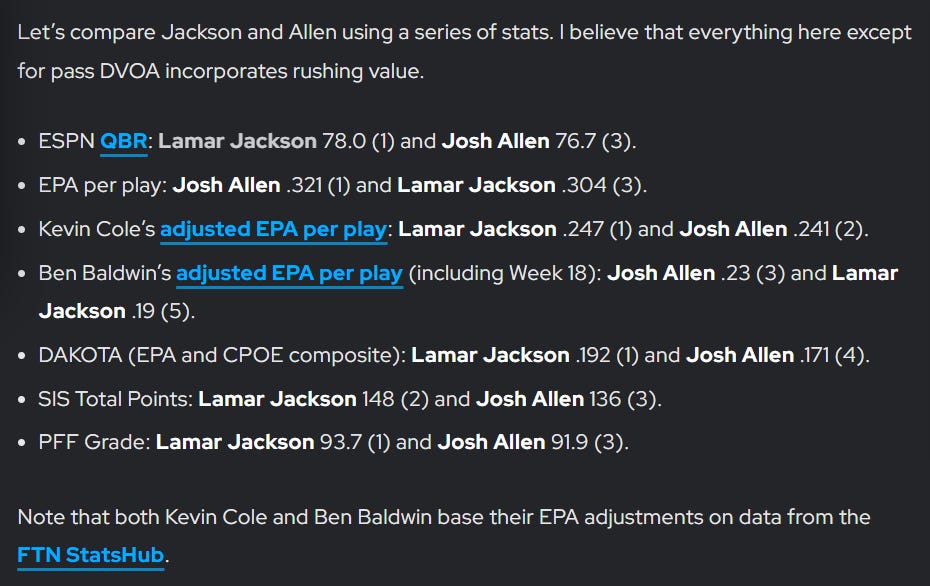
I truncated the last two bullets off Schatz’s list because I’m using them in the next section. Schatz wraps up: “So you have a case where most of the advanced stats pretty much have a tie between these two players.”
There are two points here, one explicit and one hidden:
Across the wide variety of this family of stats, Lamar and Allen alternate leading, first one then the other, so the broad result is a tie.
But even the stats that Josh Allen wins, come with an asterisk.
Here’s a list of the most noteworthy of the advanced stats, and we’ll go over what I mean:
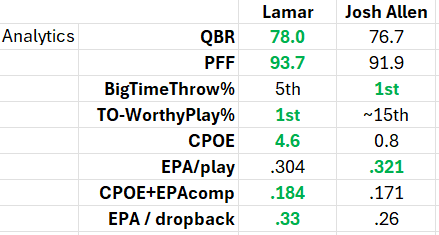
Expected Points Added per play. EPA is one of the very best “advanced analytics” tools there is. Great stuff. But!
RBSDM publishes EPA per play, and they pair it with Completion% Over Expectation. They publish a stat called CPOE-EPA composite (which I've also seen called Dakota). When they tweet this stat it's as a graph, one component on each axis. Then they do that “tiers” thing where they draw diagonal lines (slope = -1) across the graph. Top-right-most is tier 1, the second band is tier 2, etc.
Josh Allen has a small lead in EPA per play, Lamar 2nd (6th row above). Lamar has a bigger lead in CPOE, Allen 4th (5th row above). That puts Lamar noticably ahead in the CPOE+EPA composite (2nd-to-last row above). You’ll notice I have different numbers for these from what Schatz posted, but the same ranks.
We see all over these stats: Josh Allen’s “leads” are in one component of paired stats, and he actually trails in the composite or overarching stat. Here’s another:
Big-Time Throw%
This is a PFF stat. I don't subscribe to PFF; I only see their numbers when they tweet them or someone shares them in an article. Bills fans have been very eager to brag that their boy led the league in Big-Time Throw%.
Well, that makes sense. Allen has a huge arm. But one thing I do know about the PFF stat is that when PFF tweets it, they pair it with another of their stats, Turnover Worthy Play%. PFF released a column on those two stats back in week 7, here's the link.
They tweet out a graph with the two stats plotted on different axes and QBs as dots on the graph. Then they use the diagonal lines thing (slope = -1) to separate tiers. There’s an example of the graph at the link above (thru week 6 of last year).
So right away when Bills fans brag about Josh Allen leading in Big-Time Throw%, as an informed fan you immediately wonder if a piece of the story is missing.
I got the ranks for Big-Time Throw% and Turnover Worthy Play&, shown in the picture above, of an end-of-season stats tweet from PFF back in January. I didn’t save the tweet link or the graph, sorry. From the graph, PFF has both Lamar and Josh Allen in the top 5 for Big Time Throw%. But Lamar is number 1 in Turnover Worthy Play (avoidance)% while Josh Allen is middle of the pack. I show a tilde of uncertainty for this stat in the pic above, because I eyeballed these ranks off a graph. For the outliers it was easy to see a rank, but in the middle of the graph I had to put a piece of paper across my screen and count. To my eye, Allen was 16th or 17th on this axis of the graph, but I gave him a fudge factor for the inaccuracy of my method and am calling it 15th.
If both players are top 5 in one component of the rank, but Lamar is #1 in the other component, and Josh Allen is #15, then that means Lamar is ahead in the paired rank, the composite of "Big Time Throw" and "Turnover Worthy Throws". And that’s exactly what PFF’s end-of-season tweet showed in January: draw the diagonal “tier” lines on the graph, and Lamar was the top QB.
In a real sense, Josh Allen doesn’t lead in anything – really what I should say is he doesn’t cleanly win anything – not when you look at stats with their context-partner. It’s crazy how empty the statistical case is for Allen!
Here are some other “advanced analytics” stats I found on Twitter. None of these are to me as important as what we’ve looked at so far – I don’t think any of them are especially dispositive – but they’re fun. And there is a certain cumulative weight to them. No one of these is the “argument ender”, but as they stack up I want you to notice how empty the argument is that one or two statistics clinches the MVP for Josh Allen. Cherry pick much?
Start with EPA and Sack Rate in “obvious passing situations”:

There’s Lamar, way over on the far right: #1 in EPA in “obvious passing situations”.
Here’s EPA against blitz and no blitz:

Look who’s in the top right (=good) corner.
According to this next one, Lamar and Josh Allen rank similarly in throwing to their 1st read least often:

They’re both in the bottom ~6 in pct throwing to their first read (toward the far left). This hits at one of the “narratives”. If Derrick Henry is creating wide-open looks for Lamar, then wouldn’t he be able to go to his first read more often than other QBs? Lamar and Allen are top two in EPA on these throws (top of the graph). Lamar is #1.
Here’s a stat for something called “Disruption”:

The accompanying graph:
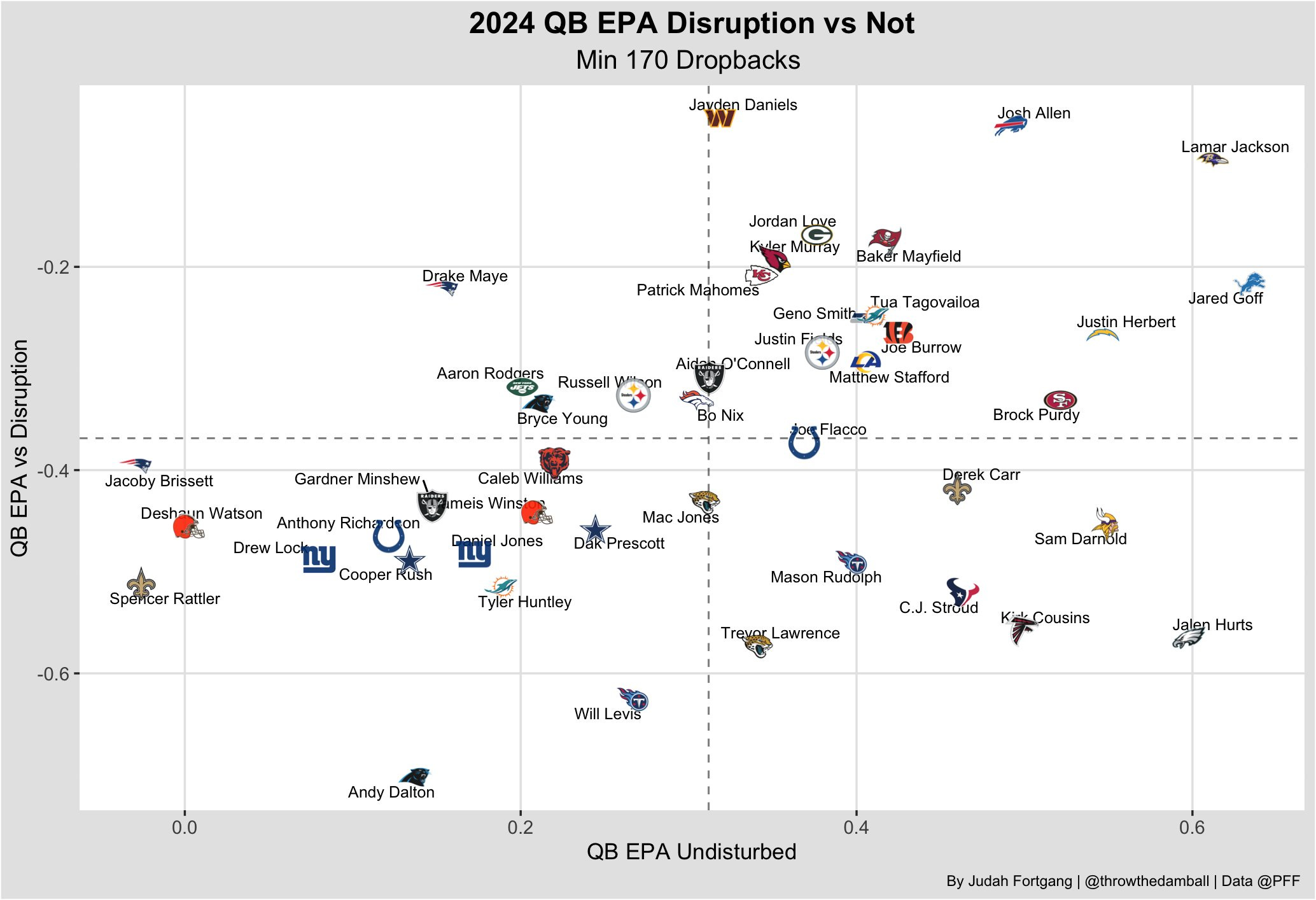
Jayden Daniels, Josh Allen and Lamar are the best in the presence of “disruption” (counting from the top). Jared Goff, Lamar, and Jalen Harts are the best in the absence of “disruption” (counting from the right). That puts Lamar alone in the top right (=good) corner of the graph.
Here’s a stat where the PFF guys offer a definition of “system” and out of system plays:

I think the word “structure” might be better. Also, I’m not sure that progressing to a 2nd or 3rd read really puts a play “out of structure” or “out of system”. But anyway, here’s the graph:
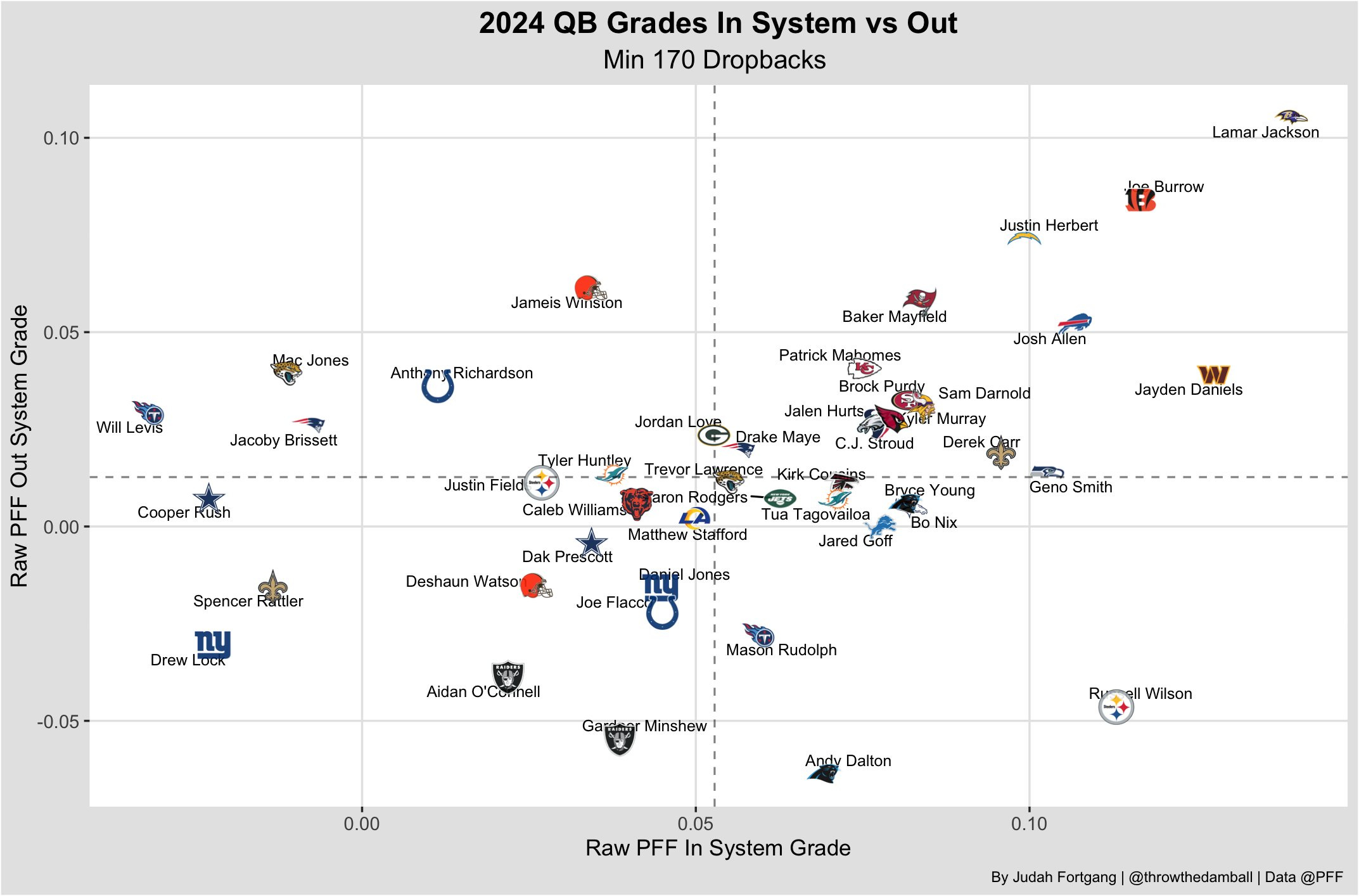
Josh Allen is #5 across one axis, and #6 across the other. One man sits #1 in both.
This family, the advanced analytics non-adjusted, is Josh Allen’s best family of stats. And he doesn’t win anything! Not cleanly, anyway.
Above in the “supporting cast” section I linked Mina Kimes & Dominique Foxworth going thru the MVP arguments for Lamar, Burrow and Allen. I want to link a different section of it here. This should start at the 19:49 mark of the podcast:
Mina starts with this:
First of all Lamar is the statistical choice, let's just start there.
Yeah!
Then she makes the case that all the stats are really friggin close. But are they, though? The raw numbers might seem “close” individually; but are they close overall if one guy wins a lot and the other guy doesn’t win anything (cleanly)?
Here, let’s veer from the “advanced” stats to develop this theme of how even Josh Allen’s stat wins are iffy or offset. These stats are a little more traditional: Sack Rate, NY/A, and passing Success Rate:
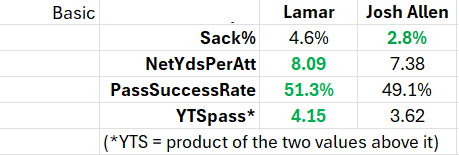
Josh Allen’s Sack Rate is sparkling: 2.8%.
Usually the players with great sack rates are the immobile snipers. Manning, Drew Brees, Marino etc all got the ball out lightning quick. It was tough for pass rushers even to get close to them. The good running QBs tend to flirt with more danger from pass rushers (because they can make them miss) and taking more risks, and that leads to more sacks even as it also leads to many explosive plays on offense. This number from Allen is unusual for a QB who can run.
Lamar just posted the best sack rate of his career; a good one, top ten in the league. Allen's is better. It's not a one-year thing for him either. Allen led the league in (lowest) sack rate in 2023. Posted a similar number in 2021. It's a great strength of his game.
And yet, Lamar is ahead of Allen in Net Yards per Attempt and in passing Success Rate, despite taking more sacks. In fact Lamar led the whole league in Net Yards per Attempt. Even with sacks factored in, Lamar has performed more efficiently as a passer. Crazy.
Even the (few) stats where Josh Allen wins, it’s not a “clean” win. It’s undermined by a loss in the paired or related stats.
Advanced Analytics, defense-adjusted
I linked Aaron Schatz;s All-Pro ballot above:
        https://ftnfantasy.com/nfl/aaron-schatz-my-2024-all-pro-ballot
He wraps up the bullet list of stats that I quoted there, with these two:
• Pass DVOA: Lamar Jackson 51.2% (1) and Josh Allen 27.0% (3).
• Adjusted DYAR with extra value for rushing: Lamar Jackson 2,126 (1) and Josh Allen 1,618 (2).
…
So you have a case where most of the advanced stats pretty much have a tie between these two players. The exception? My stats. My stats have Jackson way ahead of Allen. Jackson had one of the top 10 seasons by a quarterback in DVOA history. The Ravens had one of the best offenses in DVOA history. Certainly, this isn’t a situation where I’m picking stats over “the eye test,” because Jackson was just as impressive this year as he was last year. If my stats said one thing and all the other advanced stats said something else, I would definitely consider the idea that perhaps I was missing something with DVOA. That’s not the case this year. I’ll let DVOA and DYAR break the tie here.
Aaron is downplaying here, and personally I wish he hadn’t. Remember, last year he took a LOT of flack last year for being the one voter to keep Lamar away from a unanimous MVP. So this year he underplays. Says he’s just using his stats to break a tie.
But in fact it’s a big deal that his stats have Jackson way ahead of Allen, because his stats are adjusted for opponent. The other stats that he rattles off, which make the “tie” that he says he’s “breaking” with DVOA/DYAR, are unadjusted. The tie only exists in the non-opponent-adjusted stats! (To the extent that it’s even all that real, which we examined above.) As soon as you factor in the opponent, Allen’s accomplishments are deflated, because he played a very easy schedule, and Lamar’s accomplishments either stay where they are or possibly get inflated, because he played a hard schedule.
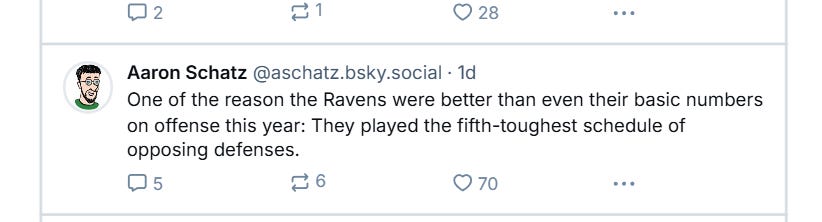
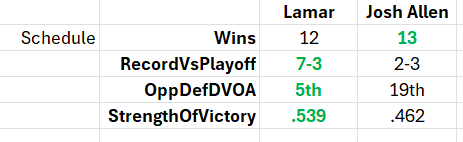
There aren’t a lot of individual stats that are opponent-adjusted. DVOA (along with its counting-stat sister DYAR) is by far the most prominent one. Above, Schatz mentions “Kevin Cole’s Adjusted EPA per Play”, which attempts to adjust for luck and opponents. Lamar and Josh Allen finish 1-2 in this, .247 to .241. Cole calls it “a razor-thin contest for MVP” on his Substack post discussing the ranking. I have some questions – but I’m not a paid subscriber so I haven’t actually read the post I just linked. It’s possible all my questions are answered. But anyway, that’s another stat that incorporates defense, that Lamar wins (but closely).
PFR has “Offensive Simple Rating System”, but that’s for the whole team. The Ravens led the Bills in that, though not by much: 8.0 to 7.8. (The Lions were #1 in that stat, with 10.6.)
We can try to roll our own defense-adjusted stat, either qualitatively or quantitatively. Here’s qualitative:
• Josh Allen led his team to 13 wins while completing 64% for 3731 with 28 TD / 6 INT, rating of 101.4, while playing 5 playoff teams and going 2-3 against them
Strength of Schedule: 27th (.467)
• Lamar led his team to 12 wins while completing 67% for 4172 with 41 TD / 4 INT, rating of 119.6, while playing 10 playoff teams and going 7-3 against them.
Strength of Schedule: 9th (.529)
What’s more impressive? 13 wins and pedestrian stats against a bottom-6 schedule, or 12 wins and historic stats against a top-10 schedule? That’s obvious, right?
Quantitative – we can multiply a basic productivity measure, say fantasy points because it’s easy, by Strength of Schedule as measured by opponent win%:
I used Yahoo fantasy points above; PFR also has a page for fantasy points, with very similar numbers (about 5 pts difference). Strength of Schedule I took from here:
This obvsly isn’t the deepest, most sophisticated analysis ever performed. But it’s striking how consistent it is with the DYAR Schatz posted (quoted at the top of this section). Lamar is 28% better than Josh Allen by the slightly naive quant approach above, and 31% better in DYAR. That’s pretty damn good for an easy off-the-cuff approach.
Lamar basically tieing with Josh Allen (not really) in unadjusted “advanced analytics” stats, while playing a much tougher schedule, is the mic drop moment for the statistical analysis. This hits the “Josh Allen did more with less” concept. Whatever Josh Allen did, and whatever he had, he did it against significantly lesser competition.
Referring back to that Mina Kimes podcast, the part where she walks thru all of the stats —
Listen, I have huge respect for Mina. She’s smarter than I am: I sure as shit didn’t get into Yale, and neither did I graduate summa cum laude from the school I did get into. She knows more football than I do. Some analysts are film guys or stat guys: she’s both a film guy and a stat guy. She clearly watches a lot of film; and while she may not have invented a cool new stat (unlike some people, ahem) she obviously knows her way around DVOA and EPA and CPOE and all the rest. Hell, she’s met (and interviewed) both Isaiah Likely and Kyle Hamilton, which I have not. Her work ethic is impressive AF: she built her NFL career with tireless effort.9
On top of all that, she can speak persuasively on issues like Dan Snyder’s assholishness and Black Lives Matter and the Deshaun Watson fiasco etc without falling on her face (unlike the vast majority of NFL analysts). Mina Kimes is a great NFL analyst; one of the best out there.
But it’s painful to watch her work thru all these stats, and almost get it, but not quite. You can watch her read the stats, repeating her point about how friggin “close” they are, and then she stumbles as she reads stats that really are not close at all.
“Lamar’s Touchdown to Interception ratio is really, really high.” Yeah: it’s historic!
But she still repeats that all the stats are really friggin close.
“Lamar is notably higher in yards per attempt ... that's a big gap. And it's remarkable that he is pushing the ball down the field but that the interceptions are as low as they are ... also in air yards per attempt he's above the rest so it's not just guys getting yards after the catch." Yeah: the single most important basic stat in passing.
But she reiterates tht the stats are really friggin close.
“DVOA, which accounts for opponent, Lamar is first, 51% value over average, Allen is third but drops to 27% ... what that reflects is that Lamar has faced the hardest schedule and that actually surprised me it was by a pretty significant margin he has faced the hardest schedule this year [of the three players].”
Yes, Mina. Despite the mantra you keep repeating, the stats are in fact not close at all.
That segment kills me. I keep waiting for the penny to drop. It doesn’t. What I think is happening here is this:
Mina is Dan Orlovsky’s friend and coworker. She values that relationship. Not in a crass careerist way; she just likes him and enjoys working with him and with their group. (Is there a more fun group of NFL talking heads than Mina + Marcus Spears + Ryan Clark + Orlovsky, moderated by Laura Rutledge? No there is not.) The snarky insulting confrontation that Scott Kasmar absolutely revels in, and I’m okay with, is not in Mina’s nature. She’s friendly and values connectedness. She maintains a collegial attitude with her coworkers: like a healthy adult.
So she gets caught in a little bit of cognitive dissonance. The coldly rational response to the stats she’s reading would be to say “Wait a fucken minute: what exactly is close about this stat picture?!?” But she’s not going to slap Orlovsky in the face like that. Not in a million years. Her co-host and friend Foxworth isn’t going to (verbally) slap her in the face on live air like that. So she struggles on thru the list.
Unusual for someone as smart as she obviously is to get caught in the cognitive dissonance like that. I bet that now she’s had time to process, she would speak about these stats differently. But that moment in time has been over for 6 months.
Traditional stats
Saving the best for last. Oh baby.
Let’s admire Lamar’s black ink on PFR’s passing stats page for the 2024 season:

Black ink in seven columns: seven beautiful columns where Lamar led the league.
From left to right:
Touchdown% – what’s better than throwing touchdowns? So fun.
Yards per Attempt – the single most important traditional basic stat for passers
Adj Yards per Attempt – this ones a little frou-frou to be honest. PFR tried to soup-up Y/A by adding some fantasy adjustments for TDs and INTs.
Passer Rating – Historic. Lamar finished with the 4th-best season in history; was in the running for breaking the record right up until the last weekend.
QBR – ESPN’s master stat. It’s a black box, so I don’t have much use for it, but the ESPN guys all use it so it’s all over Get Up, First Take, NFL Live, etc etc. The number shown doesn’t match other sources; they haveLamar with a clean lead, not a tie.
Net Yards per Attempt – the single most important basic stat, made better by accounting for sacks. If you could lead in only one number, this is it.
Adj Net Yards per Attempt – the frou-four version of NY/A, with the fantasy scoring
Beautiful.
Under the heading of “Stop, he’s already dead” let’s pull some fun stuff from PFR’s Advanced Passing page:
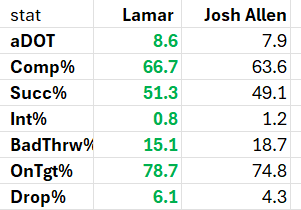
Lamar threw to a higher Avg Depth Of Target than Josh Allen did. (If you go looking for it, PFR labels this column IAY/PA: “Intended Air Yards per Pass Attempt”.) Despite that, Lamar posted a higher completion pctg. Despite the deeper targets and higher Sack Rate, Lamar still posted a higher Success Rate. Josh Allen's INT rate is excellent at 1.2%; Lamar's is better, below 1%. He also had a lower BadThrow%, and a higher OnTarget%.
Lamar had the better Completion% and Success Rate despite his receivers posting a Drop Rate 42% higher than Josh Allen’s!
If you think I’m hyperventilating over all this, you are not wrong.
Let’s back up for some perspective. Here is your complete list of every player in NFL history who has thrown 37+ TD passes and 8 or less INTs on a season:
All of those guys were either named MVP – or they went head-to-head in a season with someone else on the list (2016 and 2020) and lost the MVP to them – or they lost to Adrian Peterson rushing for 2100 and dragging Christian Ponder to the playoffs. Every single one of those guys. Until this year.
Just to put it out there, here’s a subset from that table, just the players in NFL history who’ve thrown 40+ TD passes with 5 or less INTS on a season:
That’s it, that’s the list.
I’m not saying Lamar’s season of 41 and 4 is better than when Aaron Rodgers threw 45 and 6. But it’s pretty damn good; and it IS historic.
That’s really the bottom line. Lamar had a historic season. Josh Allen very much did not.
This is the final shot at the absurd “Josh Allen did more with less” line of reasoning.
Josh Allen did much, much less. So very much less.
He did it with about the same in terms of “help” or supporting cast.
And he did it against much lesser competition.
Allen may be a great guy and a very fine Quarterback who “should” have more career awards than he had received entering 2024. But he did not earn the MVP award in 2024. That award is for the human being filling up an NFL uniform with the most value in a given season. Josh Allen simply has never been that.
If you enjoy some truly vicious snark, Scott Kacsmar got into it with Bills fans in a glorious Twitter thread toward the end of last year. He burns every bridge to the fucken ground. Here’s the thread starter:

Yeah, damn right I hearted that tweet.
There is a thread-reader unroll of that, here. But I don’t fully trust it; I think some of the best info might be in replies that the thread-reader doesn’t capture.
Many gems of info in that thread that I did not know. For example:
Josh Allen was the only Bill who turned the ball over in 2024. He threw his 6 INTs and had his 6 fumbles; no other Bill lost a fumble all season
That’s crazy.
The Bills had the best avg starting field position in the entire league:
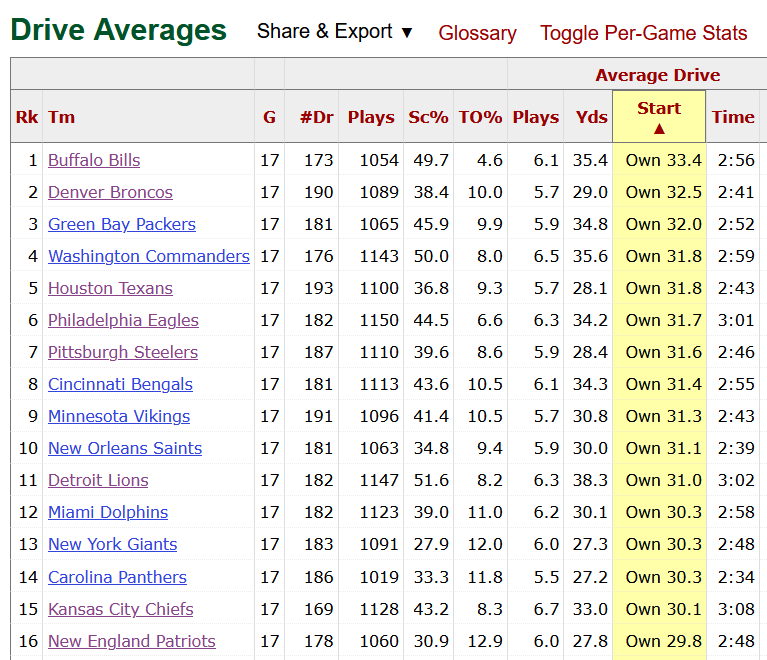
That’s crazy. The no fumbles thing and the starting field position seriously undermine Josh Allen’s MVP arguments. By the way, the Ravens were 29th in the field position stat. Kacsmar also has a great stat about which team had the longest average TD drive length in 2024; but no spoilers.
I don’t know if I’ll be able to stand Kacsmar in large doses. He’s a little too comfortable throwing around the term “DEI” for my tastes; and maybe the constant spraying of acid will get tiresome. But I do enjoy acerbic expression from a knowledgeable person; and the dude is not shy. Anway: this thread is absolutely heartwarming for the angry Ravens fan. Enjoy.
12 rushing Touchdowns!
Bills fans like to point out that Josh Allen had 12 rushing touchdown. They further like to imply that Allen therefore brings more rushing value than Lamar who only had 4 rushing touchdowns, therefore Josh Allen is the MVP.
What they're not telling you is that Josh Allen had six tush-push TDs. The Ravens don't make Lamar bang heads inside; they have a Tight End handle tush-push duties (3rd string Charlie Kolar early in the year, Mark Andrews after Kolar got hurt). I'm tossing this bullshit aside. Tush-push TDs are not a QB MVP credential.
Allen had 6 rushing TDs where he actually had to run somewhere; Lamar had 4. Allen's two longest where 26 and 13 yards. Lamar's two longest were 48 and 10 yards. Lamar's next two were 9 and 9; Allen's next two were 8 and 7. I don't see a delta here that should tip the MVP toward Allen: two rushing TDs, one of 6 yards and one of 4.
We can use these adjusted rush TDs along with the fumbles and the basic stats to construct total-TDs-to-total-Turnover ratios:
Lamar   (41 pass TDs + 4 rush TDs)         over (4 INTs + 10 fumbles)  = 45 / 14 = 3.21
Allen   (28 pass TDs + 6 "real" rush TDs) over (6 INTs + 5 fumbles)    = 34 / 11 = 3.09
This is not a case for Josh Allen being MVP over Lamar.
Yes, I discarded 6 Josh Allen rushing touchdowns. I'm not backing off that. Conceivably there was an argument that the Tush Push was a differentiator back when it was an innovation two years ago and Jalen Hurts took the Eagles to the Super Bowl. But now each contender has a Tush Push "package". Josh Allen doesn't get to be MVP just because some teams bring in a big-bodied TE for it while Allen has the same build as a big-bodied TE.
Also: fumbles
Lamar had 10 fumbles in 2024, between strip sacks and rushing fumbles. Josh Allen only had 5. That’s huge.
Ball security has been a recurring flaw in Lamar's game across the years. This is more a Lamar weakness than an Allen strength, but it's a legit win for Allen.
How do we weight it?
Allen's 5 fumbles + 6 INTs give 11 TOs to Lamar's 10 fumbles + 4 INTs = 14.
But we also know that Allen had a middle-of-the-road TurnoverWorthyThrow%, which means some INTs he threw got dropped. Meanwhile all 4 of Lamar's INTs were the receiver's fault (3 doinks or strips and 1 stopped route).
I suspect that on balance Lamar's turnover avoidance has been better. But I would need data on dropped INTs etc (which I don't have) to show it.
In the meantime Lamar threw 13 more TDs with a higher Net Yards per Att and higher Success Rate. Do 4 more fumbles undo that? I don't think so, but YMMV.
The Bills beat the Chiefs!
They were the ONLY team to beat the Chiefs (until KC rested starters in the final week). The Ravens played the Chiefs in week 1, and did not beat them.
Does that make Josh Allen MVP?
No serious person makes this argument. The AP voters might have thought about this, but they were smart enough not to expose themselves by saying this out loud. But lots of fans trumpet this victory (as they should; great win) and include it in their MVP case for Josh Allen (which they should not; it’s stupid).
If a Bills fan wants to include one and only one game from the 2024 season in their Lamar vs Josh Allen for MVP argument – the obvious game to include is game 4 of the season, when the Ravens played the Bills. Right? If you are going to pick one, and there’s a game where both players were on the same field, that’s the one you gotta pick.
The Ravens destroyed the Bills, 35-10. Lamar threw for 8.7 yds-per-attempt and 2 TDs, a Passer Rating of 135.4. The Bills threw the white flag and benched Josh Allen after the 11-min mark of the 4th quarter.
And remember that was early in the season, when the Ravens defense was still bad finding its way under their new coordinator and ironing out some big issues.
Choosing only their single best & most impressive game from the Bills schedule is disingenuous as hell. It ignores the rock-paper-scissors nature of the Bills-Chiefs-Ravens game this past season

                                     Bills beat Chiefs
                                     Chiefs beat Ravens
                                     Ravens beat Bills
I’m sorry Bills fans, but it just doesn’t do anything for you.
And we’ve already discussed Buffalo’s overall schedule in the "defense-adjusted stats” section above.
That was a great, great win and you should savor it. But it’s nothing in the MVP argument. In that context, you gotta let it go.
Bonus coverage: Lamar 2023 or Josh Allen 2024?
This question comes to us from Twitter, in the week leading up to the season opener. An aggressively truculent Lamar hater asks:
I answered somewhat diplomatically, but I think clearly:
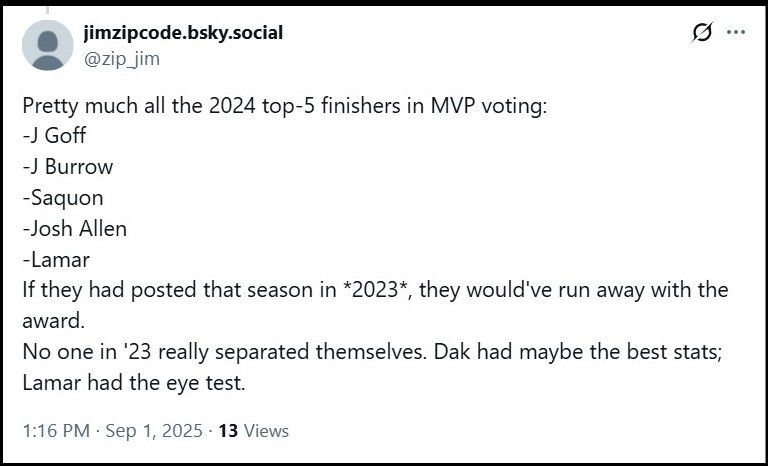
My dude detected a hint of evasiveness and pressed:
Honestly, I think this question is harder than it looks.
My initial, uh, “framework this whole offseason has been that all the major 2024 MVP contenders had better seasons than the 2023 contenders; as I put it above, transplant any of the top-5 MVP vote-getters from 2024 into the 2023 season and they would’ve won the award. That means my answer to his question “whose year was better, Lamar ‘23 or Allen ‘24” should be Josh Allen ‘24. Should be automatic. But man, did I have trouble actually typing the words.
For support I went to DVOA and DYAR, from FTN. Elsewhere in this huge tome I’ve linked Aaron Schatz’s essay on his All-Pro ballots from both 2023 and ‘24. Those have the stats in them; copying, we get:
Counting stat:
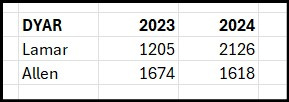
Efficiency stat:
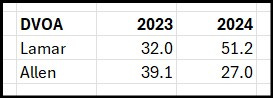
So Josh Allen did more in 2024 than Lamar did in ‘23 (counting stat), but Lamar played better (efficiency stat). That might be confusing to see, since you have to compare diagonal lines across two charts; let me put the relevant player-years together on one chart:
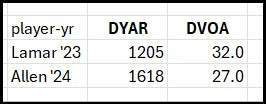
How’d they do against playoff opponents?
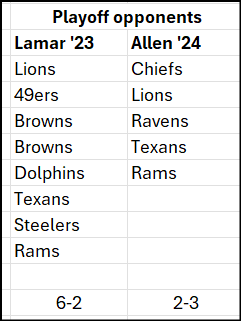
Lamar’s Ravens played 8 playoff opponents in 2023 and went 6-1. Josh Allen’s Bills played only 5 playoff opponents in 2024 and went 2-3. Remember a core weakness of Allen’s 2024 bid is his team’s soft schedule and how poor their record was against tough opponents. It’s complex though, because the teams the Bills beat were the Chiefs and Lions; their best opponents, both 15-2.
Against playoff opponents, as a passer:
• Allen had two excellent games as a passer (ratings of 117 vs Rams and 122 vs Lions), one okay game (rating of 83.6 vs the Chiefs), and two bad games (ratings of 74 vs the Ravens and 56 vs Houston).
• Lamar had three fantastic games as a passer (ratings of 158.3 vs Miami, 155.8 vs Lions, 142.5 vs browns), one good game (rating of 106 at Niners), one okay game (rating of 92.8 vs Rams), and three bad games (ratings of 79.5 vs Houston, 67.8 vs Cleveland, and 56 vs Steelers).
       Distribution of Passer Rating games vs Playoff Opponents
       Fantastic (rating over 140)             Lamar 3            —
       Great (rating 120 to 140)                   —                 —
       Excellent (rating 110 to 120)              —               Allen 2
       Good (rating 100 to 110)               Lamar 1
       Okay (rating 80 to 99)                    Lamar 1          Allen 1
       Bad  (rating 79 or lower)                Lamar 3          Allen 2
Failed to render LaTeX expression — no expression found
Statistically in those games they went:

Except Lamar played 8 games and Josh Allen only 5, so we really need to seee their per-game averages. Here they are:

Lamar did a bit better as a passer against playoff opponents (yards-per, completion%, TD%) in ‘23 than Allen did in ‘24. Allen’s rushing TDs include four 1-yd TD “runs”; 3(!) of them in one game against the Rams, the other against the Lions. (And also one great 26-yd run vs the Chiefs.) Lamar’s Ravens did not use him for tush-push TDs. His rushing TDs include one short one, a 2-yarder, and a 7- and 10-yarder.
So – what do we conclude from all this?
Hell if I know. For the most part I’m willing to let DYAR win (Allen’s 1600 to Lamar’s 1200), and stick to the story that any of the 2024 top-5 MVP vote-getters would have won if they’d posted that season in ‘23. But it’s tough to drum up any support outside of DYAR. Allen’s slate of opponents in 2024 remains notably weak; Lamar did more as a passer in 2023 against good teams than Allen did in ‘24. And Lamar’s rushing stats aren’t inflated by a bunch of tush-push TDs.
I think there’s a case to be made that Lamar’s 2023 season was better. But that’s not a battle I want to fight.
Somebody oughtta DO something!
Well: probably not.
Yeah, the wrong guy won the major award. But it’s a win for the league when the MVP vote generates “healthy discussion” and passionate debate. It’s good for them when obsessive fans write 25,000-word essays about why the chosen winner is the wrong guy. This piece, and all the social media debates, are further evidence of the NFL dominating the sports-talk landscape. That’s not something the league wants to change. Me still talking about the MVP vote six months later: that’s not something the AP wants to change.
One thing I absolutely do not think is that the AP needs to “clarify” its instructions around the award. A great strength of the process is that the AP gives the vote to 50 knowledgeable, engaged people who cover the sport closely and know what they’re talking about – and then lets them define it. Any MVP “mistakes” are fairly rare, and subtle enough that no clumsy “rules clarification” could fix them. It would just cause more and worse mistakes.
Even the impulse to boost Josh Allen so he doesn’t fall “too far behind” Lamar in career awards – that’s a perversion of a single-season award, and the source of an injustice. But the impulse itself – somewhere above I described the AP voters as “critics & tastemakers”. It’s a snide label; but it describes people who are engaged; who knew that there was a Quarterback playing magnificent ball in the frozen North these past ~4 years, without any recognition to show for it. They wanted to do something about that.
They fucked up. But the impulse to do something about that sprang from their engagement, their knowledge of the league and appreciation for its players. That’s not something that needs to be fixed. I mean, consider Orlovsky, who we’ve singled out many times in this piece. Do we think the problem is that Orlovsky wasn’t engaged enough, or didn’t care enough? Obviously not! If anything he cared too much; or cared too much about the wrong thing, getting caught up in the Romance of an “underappreciated great Quarterback”.
So no, I don’t think "something oughtta be done.” I don’t think the AP should issue a “clarification” about whether the MVP is for value or being outstanding. They’d fuck it up; and the thoughtfulness when the voters engage the question is a positive part of the process. I mean, it’d be nice if the 8 or 9 voters this piece is aimed at, got to read it. And it’d be nice if it sparked a little reaction: anger maybe (or shame, better yet). Then they’d toss it aside, but it would lodge in their subconscious and work on them. But that’s a fantasy: in this timeline, I don’t really think something oughtta be done.
I will say this though:
I didn’t expect the 2024 MVP vote. I thoroughly understand it, but I can’t justify it. And I don’t think it reflects very well on the award or the people who did the voting.
As for what I called an “injustice” – Lamar himself doesn’t seem to give a shit. He seems far more upset about the playoff loss than whether he’s got another trophy for the shelf.
Lamar’s teammates (and us fans) seem more fired-up about it than he is. I saw one AP voter joking that if the Ravens win the Super Bowl, they should thank the voters for getting the team fired-up about the perceived “disrespect” and coming out to prove the haters wrong. As if that was the piece of motivation the Ravens were missing. Ugh: eye-roll emoji.
Todd Monken had the absolute best quote on it. Asked at a press conference for his reaction to Josh Allen winning the award, Monken said “Comparison is the thief of joy.” He continued, they’re both great quarterbacks and we should just enjoy them while we have them. (Can’t find that presser right now; I’ll link it if I find it.) That obviously wins the Oscar winner for healthiest take. But maybe it’s easier to be philosophical about it when you’re in the arena and still have a solid shot at winning the Super Bowl.
How much this award “matters” depends on what these two players’ careers look like in retrospect, 10-20 years from now. If neither player ever wins another MVP, then the 2 trophies to 1 does not accurately capture how often Lamar was the best player. Josh Allen gets a boost to his Hall of Fame candidacy that he did not merit, and he gets it at Lamar’s expense.
But if Lamar goes on to win another one (or two!), then it won’t matter: 3 to 1 isn’t much different from 4 to 0. And maybe someday Josh Allen will actually be the best QB in the league and win one on his own merits. Then it’ll be appropriate for him & Lamar to be closely linked in career awards.
In the meantime: Dan Orlovsky is out on the preseason shows picking the Ravens as his likely Super Bowl winner. Lamar winning MVP the year after a snub would make for a great story. And we know the voters love a great story.
Next Up:
Training camp’s starting up! With any luck there won’t be anything important to write about, coming out of training camp. I might do a season preview; I also have some Justin Tucker thoughts percolating, that might coalesce into a piece.
Still owe this Substack a piece about Buzz Williams at Maryland, so hopefully I’ll get that out over the next couplefew weeks.
When the season starts, there will be a weekly piece about the offense, focusing on the receivers and the passing game. I’m shooting for that to appear Tuesday or Wednesday after a Sunday game. Hope you’ll follow along!
Photo credit Luke Jones
Or maybe not such a blatant error. Baseball has many more sophisticated tools of analysis these days. The official choice for 1985 NL MVP doesn’t seem so terrible, now.
Interestingly, Bill James may have had a bias (undeclared) when he wrote the Ozzie Smith capsule above. James had become a fan of manager Whitey Herzog when Herzog was managing James’ beloved Royals, 1975-79. Herzog moved over to the Cardinals in 1980; by 1987 he had won a World Series with them and also two National League championships (the “pennant”; baseball’s equivalent of a conference championship). James was in the tank for Herzog. He often wrote admiringly about Herzog’s team-building strategies, and how he handled discipline, etc. Ozzie Smith was Herzog’s shortstop on the Cards.
But it’s hard to make a straight accusation at James here: the player who won MVP that year also played for Herzog on the same team, in Center Field.
I got that history from this charming page, which I encourage you to read.
The club’s own page doesn’t say anything about safety; it says “the Club has been at the forefront of honoring players … from the grassroots level up to the professional arena. The Maxwell Football Club was the first to extend its accolades to players across all stages of their football careers.” So, I dunno.
The other thing that might need explaining on the table is that parenthetical note for 2011. The Packer’s Fullback, John Kuhn, did make 2nd-team All-Pro that year. He was a run-game thumping FB, not a receiving-type FB like say a Kyle Juszczyk or Roger Craig, so I didn’t count him for our purposes here.
Ironically, I have two major exceptions in mind, and both involve the Ravens.
(1) Justin Tucker’s career lead in Field Goal Pctg is absurd. Dude played his home games in an outdoor statium on the harbor-front, with three road games a year in outdoor stadiums next to water (a Great Lake or rivers), and his team didn’t protect him worth a damn. They constantly sent him out to attempt 50-yarders.
(2) I don’t think Lamar’s great 2025 season was achieved in such an ideal setting. Obviously he had an All-Pro caliber RB next to him. Also I think his Coordinator is top notch. But his O-line was (to put it charitably) “unsettled”; his WR corps were not a top ten group, maybe not even top half of the league; and his #1 TE was injured (unreported) for the first 4 weeks of the season.
The “great achievements imply great talent + great setting” rule is a solid one, but even good rules can have exceptions.
Actually I did. While researching this piece I found an old tweet of mine from late in the 2023 season, approaching award time, where I was like Who the hell is this guy?? Is he even a real reporter?
With a year’s perspective, I now understand the point he was making.
Obviously it didn’t exactly HURT that she’s beautiful and vivacious. But getting a foot in the door is one thing; building a career is something else.